Technical Writer Ranks #5 in Least Stressful Jobs; Also, CNN Money Total Jobs Count Screwy
October 11th, 2009 | Posted in blog 22 Comments »
CNN Money.com said technical writing is the #28 best job in the U.S., with an average salary of $67k and a projected job growth rate of 20% over ten years. Best is determined by “great pay and superior growth prospects. Work that’s meaningful.”
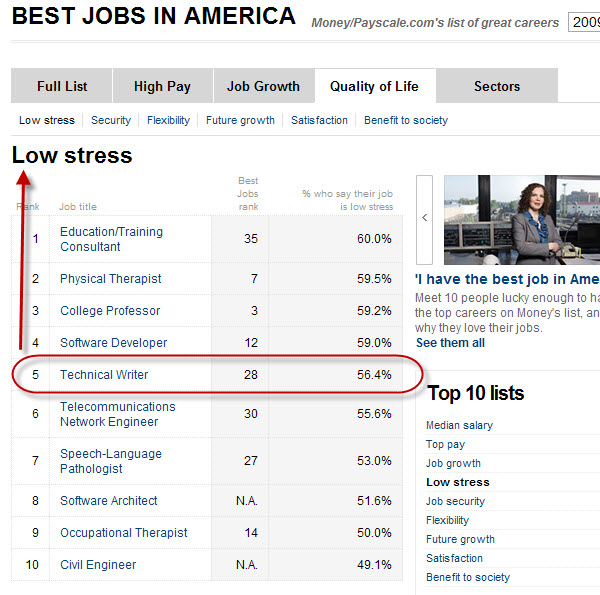
Interestingly, 56.4% of technical writers say their job is “low-stress,” which makes technical writing the fifth least stressful job in the U.S. Software developers are slightly more mellow, with 59% saying their job is low stress.
In 2006, CNN Money ranked technical writing as #13 best job with an average salary of $57k and 23% job growth. The job growth has dropped 3% but the salary shot up 10k. Somehow this made tech writing fall in their best job rankings from 13 to 28.
Compare CNN Money’s salary findings of $67k a year with the 2008 STC Salary Database report, which estimated $61,620 a year (about 5k less). The salary estimates seem to be on target. However, when you look at the total jobs, the CNN Money report falls apart.
The STC Salary Database found that “U.S. businesses employed 47,460 technical writers.” In 2006, CNN Money said there were only 50,354 technical writing jobs, and they estimated 62,000 by 2014. However, the 2009 CNN Money survey reports that there are 84,000 total jobs. They define the total jobs as the “estimated number of people working in each specific job” (which seems a normal definition).
Something is screwy here. How is it that CNN Money’s estimate of technical writer jobs is 30,000 more than their 2006 estimate and the 2008 STC Salary Database?
Maybe they defined technical writing differently?
In 2006, they defined technical writing as
Write technical materials, such as equipment manuals, appendices, or operating and maintenance instructions. May assist in layout work.
In 2009, they defined technical writing as
Write technical materials, such as equipment manuals, online help documentation, operating directions and maintenance instructions.
Not much difference here except for the addition of online help.
Maybe the data is corrupt. The footnote for the data source says, “All pay data from PayScale.com.” If you go to Payscale.com, you’ll discover that to learn any information of value, you have to register for an account and walk through a semi-long wizard of questions. My guess is that people lose their password or register multiple times at Payscale.com, creating redundancies that would throw the number of technical writer jobs askew.
But if CNN Money’s total jobs numbers are off, how can they possibly calculate job growth? Don’t they correlate their numbers with 2006 data? And if the job growth is based on incorrect information, and job growth is a factor in the “best jobs,” how can they determine the best job? In fact, why isn’t the job growth calculated astronomically here? The change from 50,000 in 2006 to 80,000 in 2009 indicates a more than 50% job growth increase. Is this just a typo? CNN Money needs to address this discrepancy if their surveys are to have any credibility.
Sponsors
Tags: career, cnn money, job growth, salary, satisfaction, stress, Technical Writing
If you liked this post, keep updated with new content: Subscribe to I'd Rather Be Writing.
Both comments and pings are currently closed.


3669 Subscribers


I don’t believe the low stress thing. I hear about the opposite. Sometimes it is in situations with pending layoffs; the TWs don’t know whether they will have a job after the layoffs. Pure stress. Sometimes, it is from bullying, an often overlooked workplace danger. Sometimes, it is poor management. Maybe the researchers for these polls and articles intentionally avoid potentially bad respondents!
I think someone could write an entire essay on this topic — are tech writing careers stressful? It would make a great post. I’m not sure how I would really approach it, though. It seems like such a relative argument that would require an analysis of the stress levels of other careers.
Hah hah, aren’t stats always fun?
Perhaps all the people writing those “appendices” are counted as negative in 2006. -30 000 people writing appendices? Appendices are so dull, it must do something to your existential state if you spend much time on them. It’s also quite a surprise that so many tech writers find our job not stressful. We’re a happy bunch!
Thanks for your comment, Sarah. I agree that the low-stress factor is a surprise, because I’m always hearing the opposite too. On the other hand, perhaps the marginalization of technical writers in IT departments allows them to feel inconsequential, that they have little to deliver, hence no stress. But otherwise, yeah, it’s always last minute emergency crisis mode type of requests for content that I feel, which is somewhat stressful.
Seriously: I just don’t get this CNN ranking at all. I do tech writing in software and it’s been a declining profession the entire time I’ve been in it (20+ years). And never the least bit low stress.
Maybe it’s other sectors where tech writing is high-growth and low stress? Biotech? Manufacturing? ?? Really. Where are all these incredibly happy tech writers?
One thing is for sure: tech writers who are on the STC office and board are not the probably the most stressful jobs right now.
Re the survey, the more I think about it, the more I feel that their research is shoddy. They don’t explain much at all about the number of surveys they conducted, who they interviewed, and what questions they asked. It’s all murky there.
How can one be sure that STC database is right and CNN is wrong? What is the methodology employed by STC to compile the statistics? All all tech writers in the US members of STC?
Dave, you have a point. STC could be wrong. But given that CNN Money’s 2006 statistics align with STC’s count, I sided with that number.
Low stress? Where do these people work? It can’t be software. Unless you find working in a place with no process, no planning, and a schedule that’s about as realistic as a science fiction movie not to be stressful. Maybe less stressful than being an Air Traffic Controller at JFK.
Hey Joe, thanks for the comment. I agree in particular that aggressive schedules contribute to stress.
Technical writing has taken a huge hit in this recession. Our jobs now are being handled in Eastern Europe, China, and India. We have even had to train these people to use a period at the end of a sentence, then seen our jobs outsourced. Most of the writers I know are back in school–in law, medicine, and finance. The jobs just aren’t in the US anymore.
Maybe that’s why it’s not a stressful occupation–none of the writers are working.
Maybe the survey was conducted before the recession? Definitely knowing that you may be laid off, because tech writers are the first to go, etc., will make your life and job more stressful.
I am a technical writer based in India. I have not seen any client teaching Indian technical writers how to use a period at the end of a sentence(even though many would love to do that). Moreover, emails from clients do contain punctuation and grammar mistakes. Documents written by native speakers also contain grammar and punctuation mistakes. If this is not the case, why is that US companies have complex and rigid document review cycles that create lots of stress?
While companies do tolerate mistakes by native writers, how is that mistakes by non-native writers a bigger crime?
Carolyn, people in India have no ambition to take away your jobs. The jobs in India will also shift once more low-cost centres appear. But true writers will not have much difficulty in finding jobs in markets like the US.
Vishnu, you’re right that grammar mistakes by non-natives seem more heinous in terms of grammar crimes. I think the assumption is that the error comes from misunderstanding correct grammar rather simply missing a typo.
I for one, find this survey from CNN a load of hooey. For the past five years, I have found my job to be more and more stressful, with companies making more demands with less planning. While hiring goes on in other departments, technical publications is neglected.
In fact at my company, while the workload and demand for documentation will explode in the next few months with new products, as of today they have decided to eliminate all two of us and outsource our jobs to India. My last day is December 12th, and I am required to transition my position to who I can only assume is someone in India.
I am bitter because I put my heart and soul into my job, and my reward is unemployment. I honestly don’t know what to do next. It seems our skills aren’t taken seriously for transition into other fields like product or project management. It is a truly scary time to be an employee in the United States.
The kicker is that technical writers make a mere fraction of what a developer makes, yet we are always seen as the liability.
Michelle,
If you are in DC or want to work in DC, reply to this email.
BTW, unfortunately I learned that it is truly a bad idea to put your heart and soul into ANY tech writing job…it is fundamentally thankless, when the whole picture is taken into account. And I agree, is hard to migrate from tech writing to ANYTHING else in IT.
Ed, good point about not putting too much heart into a project. It can be thankless. But at the same time, if you only put a half-hearted effort into a project, you run the risk of getting even less out of a project.
It is true that tech writing is indeed a stressful job. It is partly because of the aggressive schedules and getting value for the money paid as salaries.
The stress is also because of skill sets required or demanded by companies from tech writers. It is a bit incongruous. Tech writers should be good writers, good proofreaders or editors, page and graphic designers, formatting experts, and if possible, good programmers or ones with good programming knowledge, and now usability experts. Along with all these they should be good interviewers, students of complex subjects, and willing to work with salaries way below developers, testers, and even HR guys!
Do you think a single hapless individual can excel in all these areas? It is simply impossible. To all these comes unrealistic expectations, harassing schedules, and very slow career growth. The conditions of tech writers in countries like India is even pathetic.
Vishnu, you make a good point. I liked your articulation of all the requirements that companies demand of technical writers. Beyond anything else, it’s the most difficult and most challenging part of the profession. I hear all the time from writers how difficult it is to keep up with all the changing technologies, tools, and methodologies.
…why was i born in the 1990s…i’m screwed (assuming this involves career aspirations such as astrophysics) but i do agree with your point, i couldn’t do any of that if my life depended on it…
Re: Tech writers should be good writers, good proofreaders or editors, page and graphic designers, formatting experts, and if possible, good programmers or ones with good programming knowledge, and now usability experts. Along with all these they should be good interviewers, students of complex subjects, and willing to work with salaries way below developers, testers, and even HR guys!
Vishnu, this is my job description! I am a one-gal Technical Communications dept for an entire IT org and still get no respect! Low stess – Ha!
I’ve was a tech writer at a manufacturing plant for over 10 years. The job got more and more stressful, we were paid diddly squat, and we’re expected to not only write in every software application known to man…but also know how to run and fix computer hardware/software. We had to beg, borrow, and plead for every bit of information we got, and we never had all the equipment we need to do our jobs (our admin assist. used to yell at me for taking too many red pens for editing!!!). THANK GOD I went back to school. I hated that damn job.