


15 Tips for a Successful Conference Experience
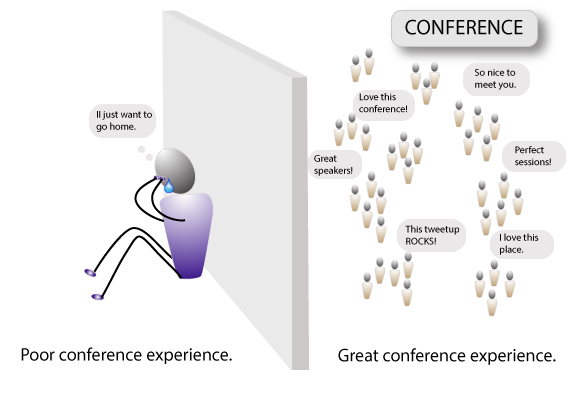
The STC Summit takes place in a few days. If you monitor the #stc12 twitter stream, you can feel the excitement of the conference attendees. I've been to at least a dozen conferences over the last seven years or so, and I've accumulated a few tips that have helped make my conference experience better. Here are my top 15 tips for a successful conference experience.
1. If you want to sightsee, arrive early.
Usually once the conference begins, you won't have time to see all the noteworthy places in the city, so if you do want to sightsee, arrive a day early. Conference sessions take place during the day, and in the evenings most of the tourist sites are closed.
2. Get lost in the city, since you have GPS on your phone.
When you do venture into the city, feel free to get lost, always knowing that you have GPS on your phone and can navigate yourself anywhere you need to -- at least until your battery runs out. Yelp and other "what's nearby" apps will help you find stores and places wherever you are.
3. Wear running shoes.
People do a lot of walking at conferences, and it always surprises me to see women wearing high-heel shoes, or men wearing dress shoes. Take along your favorite pair of running shoes or some other comfortable shoes. Not only will you walk all over a conference center, you'll also walk around the city. Feeling comfortable can put your weary traveler's body at ease.
4. Put a QR code on your business card or badge.
I've never done this, but I would like to. A QR code (like the one on my About page), can provide contact details and other information on someone's phone when they scan it with a QR reader. Business cards shuffled around typically get lost. If you make it into someone's mobile phone, however, you have a chance of being remembered.
5. Go with a problem you're trying to solve.
Write down several problems you're trying to solve before you get to the conference. This will give you purpose. If you do nothing else, follow this tip. When you browse the vendors, interact with other attendees, and listen to the sessions, keep your problems/questions in mind. They will ground your conference experience with a purpose. This purpose will help your interactions with others be much more meaningful.
6. Pick sessions based on speaker profiles.
Popular, well-known speakers are popular for a reason -- they're usually pretty entertaining. Even if the subject doesn't entirely align with your interests, a good speaker can make any topic interesting. Unless a session has a specific appeal to you based on the topic, attend the sessions with the most well-known speakers. This rarely leads to a disappointing experience.
7. When it doubt, pick the session in the biggest room.
If all sessions seem equally dull, pick the session taking place in the biggest room. Conference organizers know which sessions will be the most popular, and they allocate room sizes accordingly.
8. Listen for the non-session insights.
Although you may think the sessions themselves will provide the learning during the conference, the more significant learning takes places in more subtle ways. Listen for the non-session insights, the ideas that randomly pop into your head. These insights may arrive during a session (even when the session is about a different topic), during session breaks, at lunch, in your hotel, etc. Be on the lookout for them and recognize that these non-session insights are probably your greatest learning value.
9. Monitor and use the conference hashtag.
If you're new to Twitter, make sure you know the hashtag others are using during the conference (for example, #stc12). Use Twitterific or some other app to monitor tweets. You can also add a keyword to the hashtag, such as "#stc12 dinner" and filter tweets that way. In your tweets, rather than parroting speakers or always expressing praise, try to communicate insights, comments, or opinions.
10. Publish your notes as blog posts.
When you return to your office, your colleagues will want to know what you've learned. The notes you took during sessions will quickly fade. Try publishing your notes as blog posts. Taking notes will keep you more alert during sessions, and you can refer to your posts when others ask questions. Although most people take notes during sessions, few publish them as blog posts. When you do publish your notes as posts, no doubt you will reflect and evaluate what you're learning in a more critical way. This reflective element is yet another aspect of learning.
11. Ask questions even if you feel uncomfortable asking them.
Undoubtedly you'll be in one or more bad sessions during the conference, kicking yourself that you decided to attend that session. The speaker drones on, teaching the PowerPoint more than the audience, going in directions that bore you, and generally giving a poor presentation. When this happens, it's likely that 75% of the other attendees are feeling the same way.
You can change the flow of a bad presentation by asking a question, even if it goes in a slightly different direction than the speaker's slides. Remember my recommendation above -- to go to conferences with a problem to solve? Now is the time to unpack that question and salvage your session time.
12. Learn the art of starting a conversation.
Meeting other people is part of the conference experience, but many of us are shy introverts. Here are a few simple questions you can use to immediately start any conversation:
- What did you think of that session?
- Where are you from?
- What do you think of the conference so far?
- What session are you planning to attend next?
- What do you do at your company? (Refer to their nametag.)
These ice-breaker questions get somewhat trite after a while, but they begin any conversation. After breaking the ice, move into the questions you really want answers about (as explained in the "Go with a problem you're trying to solve" section).
13. Learn the art of ending a conversation.
When you're trapped in a conversation that you can't escape (for example, at a tweetup or other networking activity), there are several ways to get out of the conversation. Try these escape clauses. Begin, "Well, it was nice meeting you," followed by --
- I think I'm going to mingle around to the rest of the place.
- Do you have a business card?
- I'm going to get some more food.
- I think I recognize someone over there that I want to say hello to.
If none of these work, just stop talking. The other person will probably terminate the conversation for you.
14. Learn euphemisms to describe less-than-satisfying sessions.
When you attend a session that sucks, rather than saying it sucks, or coming across as a sour grape, try describing the session in a more euphemistic way:
- The speaker seemed really nice, but the session wasn't my favorite.
- I'm interested in the topic, but I didn't take many notes in the session.
- I think the speaker was a little tired.
- The session wasn't what I was expecting.
15. Bring back toys for your kids.
While you've been at the conference, your patient spouse and kids have been feeling what it's like to live without you. It's nice to bring back some presents to show you thought of them while you were gone. If you have little children, stop into a toy store and pick up some simple gifts, such as toy cars, bracelets, books, dolls, or other items. The gifts don't need to reflect the city of the conference. Simply bringing something back is usually enough to get the message across, which is Hey, I thought of you while I was gone.
Those are my tips for a successful conference. If you have any tips to add, or feedback about the above, please let me know in the comments.
About Tom Johnson

I'm an API technical writer based in the Seattle area. On this blog, I write about topics related to technical writing and communication — such as software documentation, API documentation, AI, information architecture, content strategy, writing processes, plain language, tech comm careers, and more. Check out my API documentation course if you're looking for more info about documenting APIs. Or see my posts on AI and AI course section for more on the latest in AI and tech comm.
If you're a technical writer and want to keep on top of the latest trends in the tech comm, be sure to subscribe to email updates below. You can also learn more about me or contact me. Finally, note that the opinions I express on my blog are my own points of view, not that of my employer.