Finding a Conversational Voice in Video Tutorials
November 14th, 2008 | Posted in blog 10 Comments »

Whereas an announcer just reads a script, a voice-over performer imagines who he is, who he's talking to, and where.
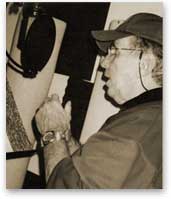
A few weeks ago I tweeted about an interesting voice over site, and my friend Kevin, who runs the Short Cummings Audio podcast, replied that a local voice-over guru in Salt Lake, Scott Shurian, gives workshops on voice.
I wanted to improve my voice-based video tutorials, podcasts, training, and presentations, so I thought I’d check it out. Scott is a nice guy and was willing to trade a blog install/design for the cost of the workshop (which lasts several weeks).
A voice over is a voice narration from a performer whom you can’t see, who reads a script in an engaging way according to the context of the script. For example, many commercials employ voice overs from professionals.
The difference between voice-over performers and announcers, Scott says, is that voice-over performers get outside of themselves, whereas announcers merely read a script.
To get outside of yourself, Scott said you must imagine who you are, who you’re talking to, and where you are. When you can imagine this context, you read the script as a performance. It’s the performance that engages listeners.
Hmmm, I thought, this no doubt applies to acting, but what about video tutorials, where I’m simply me talking to users? Scott encouraged me to imagine myself sitting in a café talking to a friend in a conversational way. He had me read a sample script imagining that I was having a natural conversation with someone I knew, in the context of a café.
Wow, you wouldn’t believe what a difference it makes when you take your mind off the idea that you’re merely reading.
As practice, Scott recommends reading a poem out lout every day. And of course not just reading the poem, but imagining a context for it –- imagining in your mind who you are, who you’re talking to, and where you’re located.
He also recommends reading obituaries, performing as if you knew the one who died, and as if you were familiar with all of his or her accomplishments. I haven’t tried either of these activities yet, but I’m jazzed about the conversational context. I’m convinced that it has to be one of the key features of a good video tutorial.
Additional Resources
Sponsors
Tags: performances, Screencasting, video tutorials, voice, voice overs
If you liked this post, keep updated with new content: Subscribe to I'd Rather Be Writing.
Both comments and pings are currently closed.


Tom–
Glad to hear that the lessons with Scott are working out. He’s a terrific teacher and I put what he taught me into practice with every episode.
KC
Scott might be a terrific teacher, but I’ll probably never know, due to content design failure.
I never buy any service or product from someone who doesn’t tell me up front how much it costs. I wouldn’t pull out a credit card to buy a shirt without knowing how much I should expect to pay (is it $30 or $300?); yet on Mr. Shurian’s website, I am expected to fill out a sign-up form without knowing how much the workshops cost, where to find that information, or where the web form will go next. Would it submit charges right away, or go to a verification page first?
Or, would it show me a list of workshop dates and locations, and prices? If so, why should I have to give personal details to get that information? If I decided against the workshop, I would have given personal information to someone I don’t know, have no relationship with, and can’t trust to destroy my data or keep it confidential.
Content design failure.
Mr. Shurian’s website lost a prospect because the prospect couldn’t find a key piece of information and didn’t want to fill out a web form without it, and had no assurance of what would be done (or perhaps, not done) with personal data. Glowing testimonials just are not strong enough to outshine those problems. My fuzzies might be a bit warmer, but that’s all.
[...] blog entry that discussed a voice-over workshop that he’s taking. You can read more about it here. Sounds like an interesting course. I wonder if there’s anything like it in Toronto (TO [...]
This is a great post. Over the past two years, my voice has been integral to my tech writing work. Phone interviews with customers for case studies, conference calls with team members in different countries, conversations with people who have English as a second language, presentations at conferences, the list goes on. Collaborators who’ve never seen my face know me only by my email and my voice. I’ve looked into local voice training, so I really appreciate these hints.
[...] Finding a Conversational Voice in Video Tutorials [...]
Great post. as Emily I’ve been using my voice for various activities around my work as I make huge load of phone calls, interviews and etc. but I really needed to get some voice training and these hints definitively will be helpful. Appreciate the work. Cheers
Nice article. Before getting into the floral business I was involved in various activities with my voice in my workplace which was a hospital. Calls, announcements etc. Back then we didn’t have a choice to go to voice training and stuff. But I so wish i did. Which would have allowed me to do my job exceptionally well.
Interesting article. I’ve been looking around your blog and most of your articles are really awesome. Speaking of the voice training I was involved in few and I have to tell you, if you are doing job concerned with your voice, you definitely need some training to get the real voice in you.
Well I too have been working as a customer service executive for few years now and we too were voice trained initially. and it really did help my confidence and many many other factors which is essential to deal with client calls
Excellent suggestions from Scott. People think sounding conversational is easy, when in fact it’s often harder than reading copy with an announcers approach. Being comfortable in front of the mic and allowing yourself to talk one-to-one with an imagined audience takes a lot of practice and skill, which is why people pay professional voice talent for their services.
best of luck with your tutorials…
chris