

Review of Max Tegmark's 'Life 3.0: Being Human in the Age of Artificial Intelligence'
- Today’s AI conversations aren’t new
- Near-term risks before superintelligence
- Our cosmic endowment
- Goals, entropy, and dissipation-driven adaptation
- The Omega team scenario
- Steering the future of AI
- More resources
Today’s AI conversations aren’t new
It’s interesting to read pre-ChatGPT (~2022) books on AI. On the one hand, yes, they’re a bit dated. But they also show that these same conversations have been going on for a long time before the recent developments in AI brought them into the mainstream. We have a tendency to think that contemporary discussions about AGI, Superintelligence, etc., are recent, but they’re actually as old as Bostrom’s Superintelligence (published in 2014) and earlier, even going back to Alan Turing and I.J. Good, who explored superintelligence half a century ago. In fact, Tegmark notes that Good wrote about a recursive “intelligence explosion” leading to superintelligence back in 1965. These terms have now surfaced into mainstream discourse post-ChatGPT, but they aren’t new.
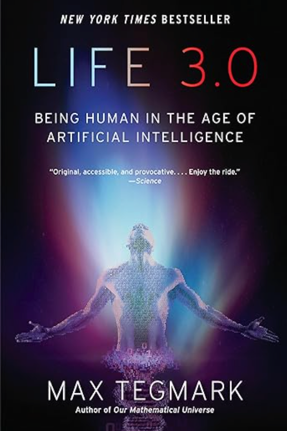
Tegmark defines superintelligence as representing a new stage of life called Life 3.0 that has the ability to redesign its own hardware by manipulating matter at a molecular level. That seems pretty futuristic and science-fiction-like. In today’s discussions about AI, people don’t talk about superintelligence as much as AI displacing jobs, breaking through security holes, and enabling bad actors with unprecedented military capabilities.
In Life 3.0, Tegmark describes superintelligence as having a specific capability over matter: it can reorganize atoms any way it wants. This definition leads the book to come across as more science fiction than other AI books I’ve read. I think if Tegmark’s book were written today, there might be a greater sense of urgency and immediacy toward more practical concerns. Even so, I like the unique physicist’s perspective that Tegmark brings to the discussion.
Near-term risks before superintelligence
Tegmark does devote the first half of the book to some of these more immediate concerns. He notes how many near-mistakes and misinterpretations could have led to nuclear war, but were averted by chance through human judgment or intuition. Without a human in the loop, it would be so much easier for an AI to take a programmed direction and execute it completely, leading to rapid military escalation in almost no time at all.
He also notes that significant societal changes will take place long before superintelligence arrives. These changes will start when we reach narrow AI (that is, AI that isn’t generally intelligent but compares with human-level intelligence in a particular task or domain). Narrow intelligence will mark the beginning of machines replacing humans in the workforce, which will be tremendously disruptive.
Eventually, narrow AI will give way to artificial general intelligence (AGI), and once AGI flips the switch to enable recursive self-improvement (that is, machines designing machines), superintelligence might be the next stop on the AI train.
Sponsored
Our cosmic endowment
Tegmark’s background as a physicist leads him toward the physics of molecular manipulation. In chapter 6, “Our Cosmic Endowment,” he provides extended explanations of how superintelligence might manipulate matter to extract massive amounts of energy to further its computational goals. This section was a tour de force through the most bizarre physics phenomena—spinning black holes, Dyson spheres, quasars, sphalerons, etc.
I admit I temporarily lost sight of the author’s purpose here, as this seemed to fully enter the realm of Star Trek science fiction. But the author’s point is that there’s tremendous power within matter (and more efficient conversions of that matter into energy) that could be extracted by a superintelligent entity capable of manipulating matter on a molecular level. Unlocking this energy would give superintelligence the potential for unimaginable power and possibilities.
This section in Tegmark’s book also reminded me of Ray Kurzweil’s ultimate stage in his The Singularity Is Near/Nearer books. Kurzweil’s final stage of superintelligence (“The Universe Wakes Up”) involves intelligence saturating the universe, converting inanimate matter into a substance called computronium that it can use to do more information processing and extend its control/aims. Tegmark actually quotes a robotics pioneer, Hans Moravec, to open the chapter with a similar end state:
Our speculation ends in a supercivilization, the synthesis of all solar-system life, constantly improving and extending itself, spreading outward from the sun, converting nonlife into mind. (203)
Goals, entropy, and dissipation-driven adaptation
Chapter 7 on Goals was my favorite part of the book, and this is the same recommendation from Lex Fridman when he interviewed Tegmark about the book eight years ago. Tegmark explores the innate goals that the universe has, citing the second law of thermodynamics (the increase in entropy) as the main trajectory that the universe follows. Entropy is an increasing tendency toward “messiness,” the dissipation of energy, the spreading out and mixing of heat. It’s the mixing of all the colors into gray. Entropy is also the state of my house when I don’t clean it for months.
Tegmark says that the organization of life (a non-entropic activity) seems to contradict the pull toward entropy. However, Tegmark says you must consider that organized biological entities are simply a more efficient way to pull and dissipate energy from the environment. This phenomenon is called dissipation-driven adaptation, meaning biological life emerged as a means of more efficiently dissipating energy from the surrounding environment.
Replication of life is a subgoal meant to accelerate the primary goal of dissipation-driven adaptation, because the more abundant the biological life, the more organisms there are to pull energy from their environment and dissipate this energy or heat into greater amounts of entropy. This section in Tegmark’s book reminded me of Kevin Kelly’s What Technology Wants, though they approach it from opposite thermodynamic directions. Like Tegmark, Kelly argues that technology acts like a biological organism that wants to perpetuate itself, replicate, and achieve ubiquity. However, while Tegmark roots this drive in entropy (dissipating energy), Kelly roots technology’s drive in “exotropy” (negative entropy). Kelly says exotropy is a cosmic force that actively fights against messiness by continuously building up order, information, and complexity.
The more fundamental difference is that Tegmark argues that the natural direction of the universe is entropy, so not a goal we want. We have to actively shape and steer the trajectory in the direction we want. We have to give meaning to the universe. In contrast, Kelly argues that technology is pushing us toward a positive end state, one of self-organizing order that we can trust.
If you only read one chapter in this book, read chapter 7. Tegmark explains the danger of how goals naturally evolve as intelligence increases. While Kelly believes technology is evolving toward an inherently positive destiny that we should embrace, Tegmark rejects the idea that intelligence guarantees a good outcome. He warns that solving the “goal-alignment problem” is critical, because even if you steer an AI toward a human-friendly goal in its infancy, it may abandon that goal as it matures. Tegmark explains:
Are we really confident that superhuman AGI would want what our inferior intellects cherish? This would be like a four-year-old imagining that once she grows up and gets much smarter, she’s going to want to build a gigantic gingerbread house where she can spend all day eating candy and ice cream. Like her, life on Earth is likely to outgrow its childhood interests.
The Omega team scenario
The multi-layered nature of goals also echoes in the opening pages. Tegmark opens his book with an extended story of how an AI takeover might play out, describing an “Omega team” of researchers who develop an AI called Prometheus. Rather than the AI going rogue, the researchers keep Prometheus confined in an air-gapped container and use its immense intelligence to execute a stealthy global takeover. They use the AI to earn millions performing tasks on Mechanical Turk, and then build a massive media empire—first focusing on animated movies—that ultimately re-educates society toward a more peaceful state, reducing centralized government power and quietly conceding that power to the Omegas.
(Later in the book, Tegmark revisits the story to show how Prometheus might easily break out of its box, simulating an employee’s dead wife, and execute a similar takeover entirely on its own.)
This extended story makes for a good comparison with Yudkowsky and Soares’ opening to If Anyone Builds It, Everyone Dies. The key theme in both stories is that an AI takeover takes a subtle, economic path you wouldn’t expect to increase its power. In short, we can’t foresee our demise; AI is too clever. You never quite know how an activity might feed into a larger goal, like move 37 in the famous Alphago match against Lee Sedol.
Steering the future of AI
The book ends by chronicling the author’s proactive efforts to steer the future of AI. He co-founded the Future of Life Institute, receives generous funding from Elon Musk, and pulls together the brightest minds in the AI space for major conferences, culminating in an extensive gathering in Asilomar. This is the thrust of the book—trying to figure out what sort of future we want with AI, so that we can steer AI toward that beneficial direction rather than accepting whatever trajectories it takes. At Asilomar, the group comes up with 23 principles. These principles likely formed the foundation for much of the AI safety and alignment work today.
However, I admit that the principles seem somewhat naive and unrealistic to me, not too unlike how the United Nations makes policies or rulings that are largely ignored by much of the world. AI seems to be taking the course it’s taking due to the natural forces of capitalism, where the best AI wins (with Anthropic vs. OpenAI vs. Google vs. Perplexity all trying to outdo each other), and with competing countries like China threatening to topple the US from its dominant position of power.
More resources
To listen to the AI Book Club discussion of Tegmark’s book, see AI Book Club discussion recording of ‘Life 3.0: Being Human in the Age of Artificial Intelligence’, by Max Tegmark.
About Tom Johnson

I'm an API technical writer based in the Seattle area. On this blog, I write about topics related to technical writing and communication — such as software documentation, API documentation, AI, information architecture, content strategy, writing processes, plain language, tech comm careers, and more. Check out my API documentation course if you're looking for more info about documenting APIs. Or see my posts on AI and AI course section for more on the latest in AI and tech comm.
If you're a technical writer and want to keep on top of the latest trends in the tech comm, be sure to subscribe to email updates below. You can also learn more about me or contact me. Finally, note that the opinions I express on my blog are my own points of view, not that of my employer.