
AI Book Club: A Human in the Loop
The AI Book Club concluded in November 2026 after reading 19 books over nearly two years. All meeting recordings, discussion notes, transcripts, and book reviews remain archived below, along with a visual gallery of all 19 books and notes on how the club was set up and run.
From April 2025 through November 2026, this book club met monthly to read and discuss popular books about AI and technology, with an emphasis on how humans, particularly technical writers, might steer and guide AI systems toward the outcomes they want.
Most of the reading list focused directly on AI. At one point, when reading back-to-back AI books started to feel repetitive, the group planned to alternate with broader technology reads, though in practice that amounted to only a couple of detours (Careless People and Breakneck) before the picks drifted back to AI. Overall, selection favored accessible trade books over engineering textbooks or manuals specifically about technical communication. Even as AI news shifted week by week, those books served as a good catalyst for thinking through longer-term changes in how people write, learn, and stay relevant alongside increasingly capable systems.
- Why the book club wrapped up
- Books discussed, recordings, and notes
- How the book club was set up and run
- Archive FAQ
Why the book club wrapped up
After reading and discussing 19 books between April 2025 and November 2026, the club reached a natural saturation point. Any book club focused on a single theme eventually exhausts its genre. Two years is probably the upper limit for a themed book club before new releases start repeating the same histories, anecdotes, and arguments.
Letting the club wrap up at the end of 2026 opens space for new adventures and smaller collaborative experiments in 2027, particularly around designing documentation for AI agents. For more reflections on ending this run, see the final ten minutes of our Co-Existence recording and Looking back at the AI Book Club one year in.
Books discussed, recordings, and notes
The table below lists all 19 sessions from most recent to oldest, with links to the meeting recordings, prep notes, discussion questions, and book reviews. You can also browse the cover gallery of all 19 books or view every related post in the ai-book-club category. Every book in the catalog has an audiobook edition, with an Audible link next to the author’s name (see Why Audible links were included).
| Meeting date | Book and description | Notes |
|---|---|---|
|
Nov 15, 2026 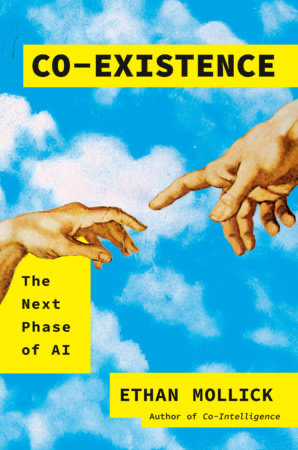 |
Co-Existence: The Next Phase of AI "How do we live alongside machines that are sometimes smarter than us? We are entering a new era. AI systems can already outperform humans in some domains while failing spectacularly in others. They can act as tutors, collaborators, researchers, strategists, and creators…yet they can also produce falsehoods, generate convincing nonsense, and fail unpredictably. The challenge is no longer simply adopting new technology. It is learning how to think, work, and live in a world where machines are sometimes smarter than us." |
|
|
Oct 18, 2026 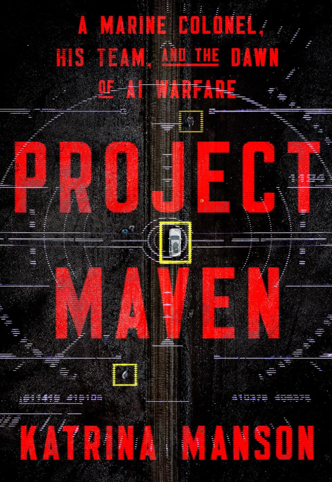 |
Project Maven: A Marine Colonel, His Team, and the Dawn of AI Warfare "The dramatic story of the secretive decade-long Pentagon campaign to bring AI-powered targeting systems onto the battlefield. In 2017, a small crew gathered in a windowless Pentagon room to put AI at the heart of how America makes war. Led by a Marine Corps colonel haunted by the deaths of US troops and prospect of AI-enhanced rivals, the Project Maven team raced to send AI into combat, igniting controversy and forever changing the US military. Summoning the mayhem of a tech startup, the group wrestled Pentagon bureaucrats and each other, enlisted an initially reluctant Silicon Valley, and convinced US forces to deploy little-tested AI systems in hot wars." |
|
|
Sep 20, 2026 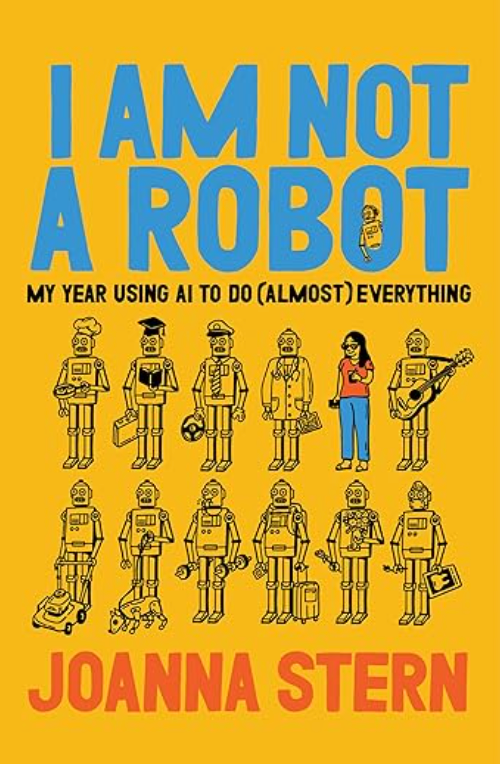 |
I Am Not a Robot: My Year Using AI to Do (Almost) Everything "I Am Not a Robot is like a time machine trip to the very near future, where AI promises to be your doctor, chauffeur, teacher, masseuse, coworker, therapist, financial planner, chef, housekeeper, and even . . . romantic partner. Your colleague might be using ChatGPT to write emails at work, but Joanna used AI tools and robots to do household chores, to manage her health, and to transport her family on vacation. If there was a decision to make or a task to do, she let AI go first. Along the way, she conducted exclusive interviews with the tech leaders building this future, then reported back from the front lines as your funny, no-nonsense tour guide." |
|
|
Aug 16, 2026 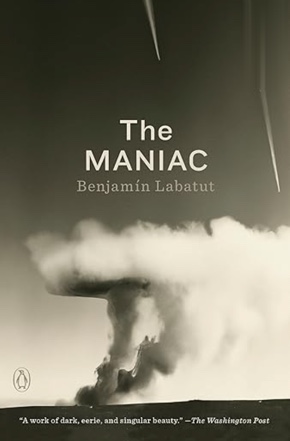 |
"A prodigy whose gifts terrified the people around him, John von Neumann transformed every field he touched, inventing game theory and the first programable computer, and pioneering AI, digital life, and cellular automata. Through a chorus of family members, friends, colleagues, and rivals, Labatut shows us the evolution of a mind unmatched and of a body of work that has unmoored the world in its wake." |
|
|
June 28, 2026 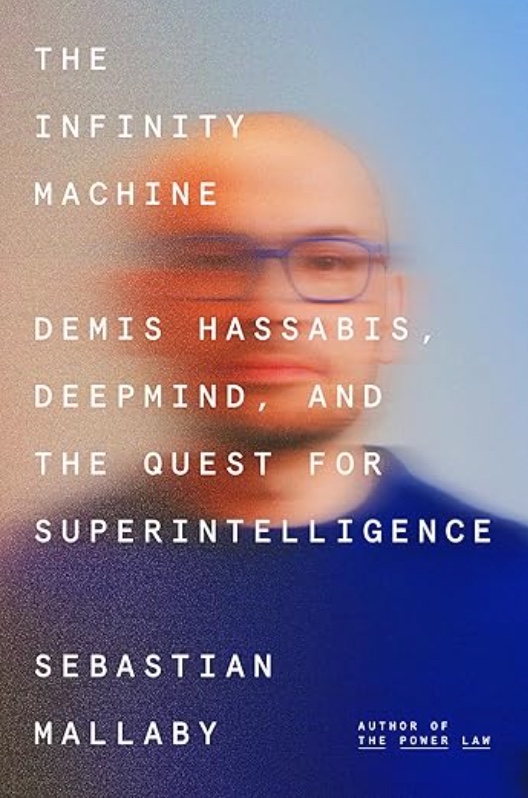 |
The Infinity Machine: Demis Hassabis, DeepMind, and the Quest for Superintelligence "From one of our leading chroniclers of the intersection of innovation and capitalism, a landmark reckoning—based on unprecedented access—with one of the world's most brilliant and driven tech visionaries, and his game-changing company." |
|
|
May 17, 2026 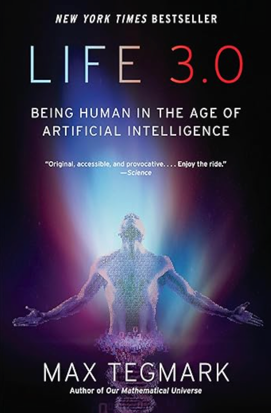 |
Life 3.0: Being Human in the Age of Artificial Intelligence "How will Artificial Intelligence affect crime, war, justice, jobs, society and our very sense of being human? The rise of AI has the potential to transform our future more than any other technology—and there's nobody better qualified or situated to explore that future than Max Tegmark." |
Meeting recording |
|
Apr 19, 2026 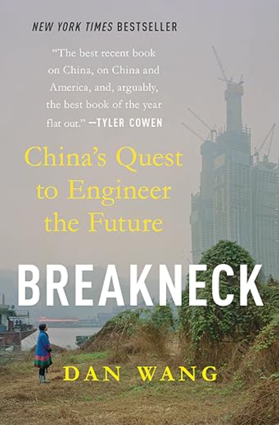 |
Breakneck: China's Quest to Engineer the Future "In Breakneck, Wang blends political, economic, and philosophical analysis with reportage to reveal a provocative new framework for understanding China―one that helps us see America more clearly, too. While China is an engineering state, relentlessly pursuing megaprojects, the United States has stalled. America has transformed into a lawyerly society, reflexively blocking everything, good and bad" |
|
|
Mar 15, 2026  |
If Anyone Builds It, Everyone Dies: Why Superhuman AI Would Kill Us All "In 2023, hundreds of AI luminaries signed an open letter warning that artificial intelligence poses a serious risk of human extinction. Since then, the AI race has only intensified. Companies and countries are rushing to build machines that will be smarter than any person. And the world is devastatingly unprepared for what would come next." |
Meeting recording |
|
Feb 15, 2026 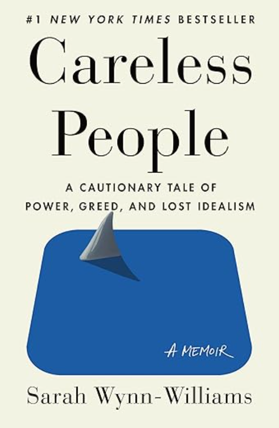 |
Careless People: A Cautionary Tale of Power, Greed, and Lost Idealism "Careless People is a deeply personal account of why and how things have gone so horribly wrong in the past decade―told in a sharp, candid, and utterly disarming voice. A deep, unflinching look at the role that social media has assumed in our lives, Careless People reveals the truth about the leaders of Facebook: how the more power they grasp, the less responsible they become and the consequences this has for all of us." |
|
|
Jan 18, 2026 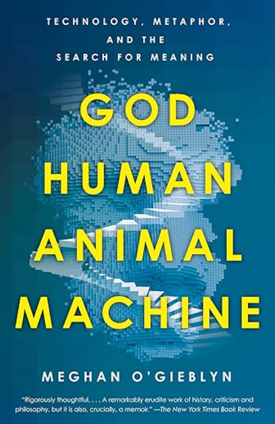 |
God, Human, Animal, Machine: Technology, Metaphor, and the Search for Meaning "For most of human history the world was a magical and enchanted place ruled by forces beyond our understanding. The rise of science and Descartes's division of mind from world made materialism our ruling paradigm, in the process asking whether our own consciousness — i.e., souls—might be illusions. Now the inexorable rise of technology, with artificial intelligences that surpass our comprehension and control, and the spread of digital metaphors for self-understanding, the core questions of existence—identity, knowledge, the very nature and purpose of life itself—urgently require rethinking." |
|
|
Dec 14, 2025 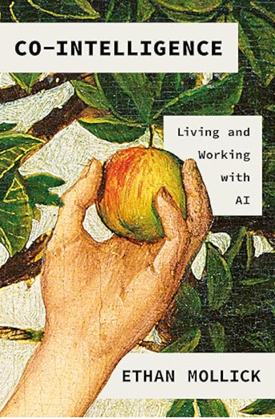 |
Co-Intelligence: Living and Working with AI "In Co-Intelligence, Mollick urges us to engage with AI as co-worker, co-teacher, and coach. He assesses its profound impact on business and education, using dozens of real-time examples of AI in action. Co-Intelligence shows what it means to think and work together with smart machines, and why it's imperative that we master that skill. / Mollick challenges us to utilize AI's enormous power without losing our identity, to learn from it without being misled, and to harness its gifts to create a better human future. Wide ranging, hugely thought-provoking, optimistic, and lucid, Co-Intelligence reveals the promise and power of this new era." |
Meeting recording |
|
Nov 16, 2025  |
Nexus: A Brief History of Information Networks from the Stone Age to AI "Nexus looks through the long lens of human history to consider how the flow of information has shaped us, and our world. Taking us from the Stone Age, through the canonization of the Bible, early modern witch-hunts, Stalinism, Nazism, and the resurgence of populism today, Yuval Noah Harari asks us to consider the complex relationship between information and truth, bureaucracy and mythology, wisdom and power. He explores how different societies and political systems throughout history have wielded information to achieve their goals, for good and ill. And he addresses the urgent choices we face as non-human intelligence threatens our very existence." |
Meeting recording |
|
Oct 19, 2025  |
Hands-On Large Language Models: Language Understanding and Generation "AI has acquired startling new language capabilities in just the past few years. Driven by rapid advances in deep learning, language AI systems are able to write and understand text better than ever before. This trend is enabling new features, products, and entire industries. Through this book's visually educational nature, readers will learn practical tools and concepts they need to use these capabilities today. / You'll understand how to use pretrained large language models for use cases like copywriting and summarization; create semantic search systems that go beyond keyword matching; and use existing libraries and pretrained models for text classification, search, and clusterings." |
|
|
Sep 21, 2025  |
Empire of AI: Dreams and Nightmares in Sam Altman's OpenAI "[Hao] realized that the core truth of this massively disruptive sector is that its vision of success requires an almost unprecedented amount of resources: the “compute” power of high-end chips and the processing capacity to create massive large language models, the sheer volume of data that needs to be amassed at scale, the humans “cleaning up” that data for sweatshop wages throughout the Global South, and a truly alarming spike in the usage of energy and water underlying it all. The truth is that we have entered a new and ominous age of empire: only a small handful of globally scaled companies can even enter the field of play. At the head of the pack with its ChatGPT breakthrough, how would OpenAI resist such temptations?" |
Meeting recording |
|
Aug 17, 2025  |
AI Superpowers: China, Silicon Valley, and the New World Order "...Lee argues powerfully that because of the unprecedented developments in AI, dramatic changes will be happening much sooner than many of us expected.... Most experts already say that AI will have a devastating impact on blue-collar jobs. But Lee predicts that Chinese and American AI will have a strong impact on white-collar jobs as well. Is universal basic income the solution? In Lee's opinion, probably not. But he provides a clear description of which jobs will be affected and how soon, which jobs can be enhanced with AI, and most importantly, how we can provide solutions to some of the most profound changes in the future of human history." |
|
|
Jul 20, 2025  |
Supremacy: AI, ChatGPT, and the Race that Will Change the World "In Supremacy, Olson, tech writer at Bloomberg, tells the astonishing story of the battle between these two AI firms [ OpenAI and DeepMind], their struggles to use their tech for good, and the hazardous direction they could go as they serve two tech Goliaths whose power is unprecedented in history. The story focuses on the continuing rivalry of two key CEOs at the center of it all, who cultivated a religion around their mission to build god-like super intelligent machines: Sam Altman, CEO of OpenAI, and Demis Hassabis, the CEO of DeepMind." |
Notes and discussion |
|
Jun 15, 2025  |
The Singularity Is Nearer: When We Merge with AI "Kurzweil brings a fresh perspective to advances toward the Singularity — assessing his 1999 prediction that AI will reach human level intelligence by 2029 and examining the exponential growth of technology — that, in the near future, will expand human intelligence a millionfold and change human life forever. Among the topics he discusses are rebuilding the world, atom by atom with devices like nanobots; radical life extension beyond the current age limit of 120; reinventing intelligence by connecting our brains to the cloud; ... and the growth of renewable energy and 3-D printing." |
|
|
May 18, 2025  |
The Coming Wave: Technology, Power, and the 21st Century's Greatest Dilemma "In The Coming Wave, Suleyman shows how these forces will create immense prosperity but also threaten the nation-state, the foundation of global order. As our fragile governments sleepwalk into disaster, we face an existential dilemma: unprecedented harms on one side, the threat of overbearing surveillance on the other. / How do we ensure the flourishing of humankind? How do we maintain control? ... / This groundbreaking book from the ultimate AI insider establishes 'the containment problem'—the task of maintaining control over powerful technologies—as the essential challenge of our age." |
|
|
Apr 20, 2025  |
More Than Words: How to Think About Writing in the Age of AI "More Than Words argues that generative AI programs like ChatGPT not only can kill the student essay but should, since these assignments don't challenge students to do the real work of writing. To Warner, writing is thinking—discovering your ideas while trying to capture them on a page—and feeling—grappling with what it fundamentally means to be human. The fact that we ask students to complete so many assignments that a machine could do is a sign that something has gone very wrong with writing instruction. More Than Words calls for us to use AI as an opportunity to reckon with how we work with words—and how all of us should rethink our relationship with writing." |
Meeting recording |
How the book club was set up and run
If you’re curious how an online book club like this comes together, or want a blueprint for starting one of your own, the sections below preserve how the group was organized and run from 2025 to 2026. Keeping the operational setup lightweight made it sustainable to run monthly sessions for nearly two years alongside full-time work.
Reading pace and monthly schedule
The club read one book a month and met online on the third Sunday of each month at 10am Pacific Time. There was no cost to participate beyond getting the books, and members could drop in for as few or as many sessions as they liked, whether they finished the whole book or only part of it.
Meeting on a Sunday morning didn’t fit everyone’s schedule, and that turned out to be fine because this was a book club rather than a workplace webinar. Holding sessions on Sundays filtered naturally for people who wanted to do the reading and talk about the substance of the books, while anyone who couldn’t make the live call could listen to the podcast episode or watch the recording afterward.
Live attendance averaged roughly four to eight people per session, which proved to be the right size. Much like a dinner table conversation, four to eight participants gives everyone room to speak and build on each other’s points, whereas groups past ten or twelve tend to turn most attendees into bystanders watching a panel.
Prep docs, recordings, and shownotes
Before each monthly call, a shared Google Doc summarized the book’s main arguments and listed a handful of discussion questions to get the conversation moving. Sessions started out on Google Meet and later moved to Riverside for cleaner multi-track audio and video recording.
After each meeting, the video went up on YouTube and the audio went out through the site’s podcast feed, paired with a blog post containing topic takeaways, a standalone narrative essay drawn from the conversation, and a cleaned-up transcript. Because public sharing was central to the format, recording consent was stated upfront for anyone joining a live call, with an open offer to edit out any segment a participant asked to remove afterward.
Why Audible links were included
Every entry in the reading list included an Audible link alongside the Amazon print link because audiobooks were how I got through most of the reading while riding my bike, commuting in the car, or working in the yard with my hands busy and my ears free. A title that existed only in print was much harder to finish on a monthly schedule. That preference didn’t affect how other members read the books, of course, though it meant print-only releases usually lost out during book selection, and all 19 books we read ended up having audiobook editions.
Notifications, chat, and calendar setup
To coordinate between monthly calls without creating heavy administrative overhead, the club relied on three simple channels that have since been retired:
- Slack workspace: A dedicated free-tier Slack workspace gave members a place to introduce themselves, suggest upcoming books, and share articles between sessions, though most of the real discussion stayed in the live monthly calls. Because Slack’s free tier clears messages after 30 days and paid retention costs far too much for an informal hobby group, the workspace operated as an ephemeral rolling chat rather than a permanent archive.
- Email announcement list: An embedded Mailjet signup form on this page sent monthly reminders, reading picks, and discussion doc links to people who preferred email over checking another Slack workspace.
- Google Group calendar sync: Joining a companion Google Group automatically placed the recurring monthly meeting and video room link onto members’ Google Calendars, supplemented by a one-click calendar template button for anyone adding individual dates manually.
Archive FAQ
- Who was the audience for this book club?
- The club drew mostly technical writers and people in adjacent tech roles who wanted to broaden their understanding of AI without diving into machine learning math or model engineering. Most of the participants worked in technical communication, though anyone interested in the books was welcome to join.
- How were the books chosen?
- Selection favored popular, well-reviewed trade books, generally titles with hundreds of ratings averaging around four stars or higher, along with an audiobook edition on Audible. Within the AI theme, the list spanned lab histories, alignment debates, practical guides, and literary nonfiction, plus a couple of broader tech detours when straight AI books started feeling repetitive.
- What were the meetings like?
- Sessions were informal, interactive, and discussion-driven rather than presentation-based. Most meetings kicked off by having everyone rate the book out of five stars to see where opinions split, then moved through whichever themes from the prep doc sparked the most debate.
- Wasn’t AI changing too fast for books?
- In some ways, yes, and practical how-to books dated fastest of all, sometimes within six months of publication. However, the strongest books on the list wrestled with human, organizational, and historical questions that outlast individual model releases, while offering a slower, more reflective counterweight to daily AI news feeds.
- Why read 300-page books instead of shorter articles?
- Long-form reading slows the brain down in a way that scrolling through short posts and summaries never does. Committing to a book a month acted as a forcing function to step away from fragmented online feeds and spend sustained time following an author’s full argument, which turned out to be one of the best reasons to run the club in the first place.
About Tom Johnson

I'm an API technical writer based in the Seattle area. On this blog, I write about topics related to technical writing and communication — such as software documentation, API documentation, AI, information architecture, content strategy, writing processes, agent skills, tech comm careers, and more. Check out my AI courses for more on the latest in AI and tech comm. If you're looking for info about documenting APIs, see my API documentation course.
If you're a technical writer and want to keep on top of the latest trends in tech comm, be sure to subscribe to email updates below. You can also learn more about me or contact me.
Finally, I want to note a couple of things. I usually write the first drafts of my posts myself and then use AI to improve accuracy, clarity, and detail in places, so my writing is a mix of human and AI. (Hopefully that's not too off-putting.) Also, the opinions I express on my blog are my own perspectives, not those of my employer.