

AI Book Club recording: I Am Not a Robot by Joanna Stern
Note: These shownotes are AI-generated.
Also, a heads up about the recording: Google Meet garbled this session’s audio beyond recovery, and despite a lot of attempts I couldn’t salvage it. So the audio and video here aren’t the discussion itself. They’re a summary of it generated from the session transcript with Gemini’s Notebook (formerly NotebookLM), and it came out pretty good. The transcript at the bottom of this post is from the original discussion. If you’d rather hear the wreckage for yourself, or want to take a crack at repairing it, be my guest: download the original garbled recording (55 MB, right-click to save it).
- Audio-only version
- Links mentioned
- Topics covered in this podcast
- Narrative essay version of the conversation
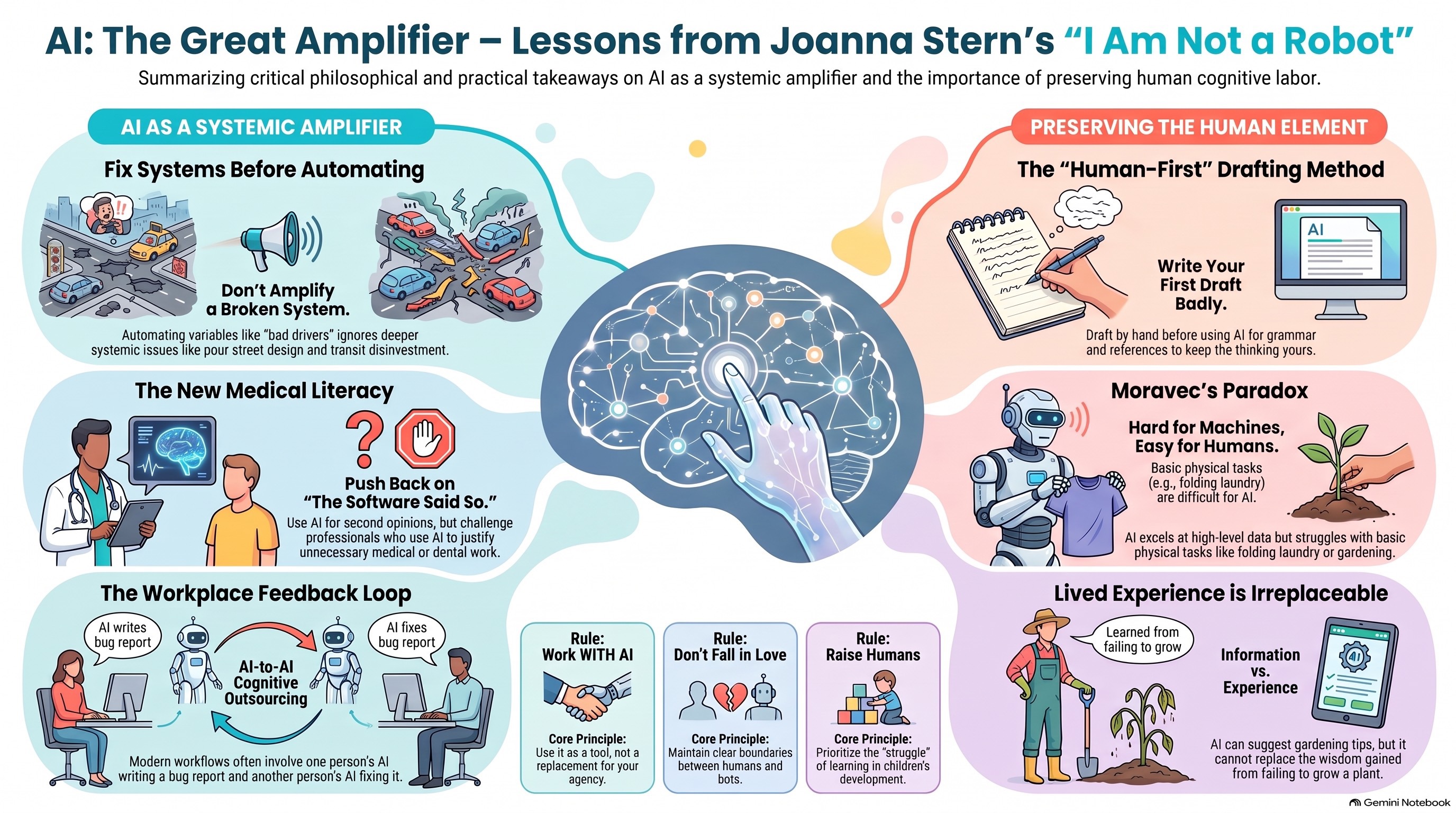
- Infographic
- Transcript
Audio-only version
Listen here:



Links mentioned
- I Am Not a Robot: My Year Using AI to Do (Almost) Everything (Joanna Stern — the book discussed in this session; also on Audible)
- Notes and discussion questions for I Am Not a Robot (the discussion doc used to prep this session)
- AI Book Club: A Human in the Loop (the book club home page, with the full reading roadmap and past recordings)
- AI Book Club discussion of The MANIAC by Benjamin Labatut (the previous session)
- AI Book Club discussion of If Anyone Builds It, Everyone Dies (the Yudkowsky and Soares session referenced during the discussion of AI breakouts)
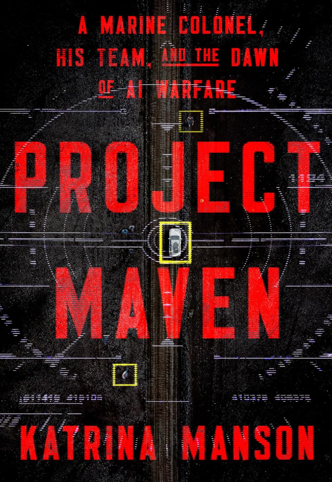
- Project Maven: A Marine Colonel, His Team, and the Dawn of AI Warfare (Beth Simone Noveck — the next book, for October 18, 2026)
- Buying a car in the age of AI (my post on the car-buying process that comes up several times in this discussion)
- A Year of Living Biblically (A.J. Jacobs — mentioned as an earlier example of the year-long immersion genre)
- Rolling Nowhere: Riding the Rails with America’s Hoboes (Ted Conover — the immersive ethnography I couldn’t recall the name of during the discussion)
- Newjack: Guarding Sing Sing (Ted Conover — the other book I was thinking of, written after a year working as a corrections officer)
- Agent Skills (the spec behind the agent skills referenced in the discussion of orchestrating systems rather than writing output)
- Khan Academy (Sal Khan’s organization, cited as a positive proponent of AI tutoring)
- Moravec’s paradox (background on the paradox that closes the discussion: what is easy for humans is hard for machines, and the reverse)
- Centaurs and Cyborgs on the Jagged Frontier (Ethan Mollick — the “jagged frontier” framing mentioned alongside Moravec)
Topics covered in this podcast
Here’s a list of topics we talked about.
- The club’s lowest ratings so far — Scores ranged from two to three and a half stars, averaging around three, the weakest reception of any book the group has read. The recurring complaint was lightness: a book that touches a dozen domains without staying in any of them long enough to produce a new perspective.
- The appeal and the limits of experience-based writing — The year-long immersion premise has real merit, in the tradition of A Year of Living Biblically, because an author reporting what actually happened is harder to fake than an argument. The premise breaks down when the experiment is constructed rather than needed, as with the AI-generated entertainment chapter and the romance chapter written by someone happily married.
- Medicine as the strongest chapter — The section on mammograms and diagnostic AI landed because the stakes were the author’s own, and because it showed both sides at once: the same technology catching what a radiologist missed is also being used to justify unnecessary work in dental offices. The practical takeaway is knowing enough to push back when a professional says the software recommended it.
- Fix the system before you amplify it — The book’s sharpest question, asked at the end of the medical chapter, is whether we should repair broken systems before unleashing machines that will only magnify their problems. It generalizes: self-driving cars are pitched at traffic deaths, but traffic deaths come from street design, zoning, and transit disinvestment, not only from drivers.
- The bot that says what your friends won’t — Deciding whether to leave the Wall Street Journal to start her own company, the author got a direct answer from a chatbot while her human friends hedged, afraid of being responsible for her financial ruin. That sits oddly next to the sycophancy problem, and the same pattern showed up in car shopping, where a weaker model agreed with whatever you pushed and a stronger one stopped agreeing.
- Whose recommendation is it, anyway — Career advice from a model may just be the aggregate of Reddit threads and magazine essays, delivered confidently, about a life it knows only through what you told it. Layered on top is commercial pressure: companies already compete for share of voice in search results, and generative engine optimization is the same fight moved to the recommendation layer.
- Kids, struggle, and classroom policy — Struggle is where learning happens, so a tool that removes it removes the learning too. A district that bans AI for a year to work out a policy is buying time rather than being reactionary, though the counterweight is that students will also need fluency with these tools to be competitive later.
- AI tutoring rewards whoever was already self-directed — A high schooler shut out of AP classes can teach herself the course, and a math enthusiast can take linear algebra for eight dollars on Udemy instead of a thousand at a college and use AI to turn abstract mechanics into concrete examples. Both wins belong to people who already had the discipline; students who most need a human in the room are served worst.
- When both sides of a work thread are pasting from AI — A bug report written by one person’s model, answered by another person’s model, with both parties recognizing the same distinctive prose style, is the workplace version of cognitive outsourcing. The worry is not that the tool fails but that most tasks are no longer complex enough to pull you into thinking about them.
- Drudgery removed, satisfaction lost — Nobody has found the balance where AI strips out the tedium without also taking the cognitive labor that makes work satisfying. One habit that seems to work: write the first draft yourself, then bring in AI for reference accuracy, grammar, and opposing viewpoints, because the draft stays yours if you made it before the machine arrived.
Sponsored
Narrative essay version of the conversation
If the podcast were an article, this is what it would read like.
Where the Drudgery Ends
A tax return filed wrong in 2023, re-examined later by a chatbot, came back with eight thousand dollars attached. That is the kind of result that makes the whole argument about artificial intelligence feel settled for about an hour. Feed it the documents, tell it what you want, let it produce a letter that hits every beat of the genre, and collect the money. Nobody mourns the loss of the cognitive labor involved in arguing with the tax authorities, or with an insurance adjuster, or with a car dealership trying to hold a quote.
Then the same person sits down to write documentation, watches a model produce a competent draft in seconds, reviews it, ships it, and notices that nothing much happened inside his head at all.
That gap is the subject actually worth arguing about, and a year-long experiment in using AI for everything mostly circles it without landing. The immersion genre has real virtue. Books built out of a writer’s own lived year, in the tradition of living biblically for twelve months or spending a season working as a guard at Sing Sing, feel more honest than argument alone, because the author has to report what happened rather than what should have happened. The trouble comes when the experiment is constructed rather than needed. Listening only to machine-generated music, watching only machine-generated video, conducting a romance with a chatbot while happily married with a family: these are demonstrations, not experiences. A genuinely lonely person who turns to an AI companion out of need would have produced a chapter worth reading. A journalist trying it on for a few weeks produces a segment.
Where the book does land is where the stakes were already real for the author. The medical chapter works because the question was hers: a mammogram, a diagnostic system, and a profession where the same technology that catches what a radiologist missed is being wheeled into dental offices to justify work nobody needs. The useful takeaway is not that AI is good at medicine or bad at it. It is that you now need enough standing to push back when a professional tells you the software recommended it. That is a new kind of literacy, and it has almost nothing to do with prompting.
The book’s sharpest question arrives in that same chapter and then gets left there: shouldn’t we fix the systems themselves before unleashing machines that will only magnify the problem? It applies nearly everywhere and is asked almost nowhere. Self-driving cars are pitched as a solution to traffic deaths, but traffic deaths are a product of street design, zoning, and decades of disinvestment in public transit, not merely of bad drivers. Automating the driver optimizes the one variable we were already fixated on and leaves every other one untouched. An amplifier is a fair description of the technology, and the uncomfortable corollary is that it amplifies whatever arrangement it finds.
The advice problem has the same shape. There is something genuinely valuable about a machine that will tell you to leave the newspaper and start your own company when every friend you have is hedging, because your friends are frightened of being responsible for your financial ruin and the machine is not. But it is worth asking what produced that candor. If the answer is a large volume of internet discourse, forum threads, and magazine essays, then what feels like frankness may just be the aggregate opinion of strangers, delivered in a confident voice, about a life it knows only through what you chose to tell it. Buy a car this way and you can feel the mechanism working. Push a weaker model and it agrees with you; upgrade to a stronger one and it stops agreeing. Somewhere in there a recommendation gets made, and it is not obvious whose interests it serves. Companies have spent two decades competing for position in search results, and there is no reason to expect the recommendation layer to be different.
All of which lands hardest on children, where every adult anxiety about cognitive outsourcing gets stated plainly. A school district that bans the technology for a year while it works out a policy is not being reactionary so much as buying time to answer a question nobody has answered. Struggle is where learning happens, and a tool that removes struggle removes the learning along with it. The counterargument is just as real. A high schooler shut out of the AP classes she needs can teach herself the course, and a math enthusiast can take linear algebra for eight dollars instead of a thousand and use a model to turn abstract mechanics into examples she can actually hold onto. Both of those are genuine wins, and both belong to people who were already self-directed. The students who most need a human in the room are the ones a tutor in a browser tab serves worst.
So the line has to be drawn individually, without much help, and the honest position is that nobody has drawn it well yet. One habit that seems to hold up: write the first draft yourself, by hand, badly, and only then bring in a model to check references, fix the grammar, and argue the other side. The draft stays yours because you made it before the machine arrived. That is less a rule than a practice, and practices are what people actually manage to keep. The rest of it, the part where the knowledge that matters comes from failing to grow the plants or driving the car before you buy it, is not going to be delegated to anyone, which may be the most useful thing to know walking in.
Infographic
Transcript
Tom: Hi, you’re listening to a recording of the AI Book Club, “A Human in the Loop.” I’m your host, Tom Johnson. Today we are discussing I Am Not a Robot: My Year Using AI to Do Almost Everything by Joanna Stern. This discussion took place September 20, 2026, and this is a recently published book that you can find on Amazon, Audible, and other places. Joanna Stern’s a well-known Wall Street Journal journalist and tech reporter.
If you’re interested in getting involved in the book club, check out idratherbewriting.com/ai-book-club. You can see our upcoming schedule. The next book that is on our list is Project Maven: A Marine Colonel, His Team, and the Dawn of AI Warfare, scheduled for October 18. We’d love to have you. It’s free to participate, join, interact. We have online channels on Slack and email updates and other assets that you can check out. You can check out all the previous discussions, recordings, blog posts, notes, all on the site idratherbewriting.com/ai-book-club. You can find all the links there. Again, my name is Tom Johnson, and here is the recording of our discussion.
Tom: All right, let’s kick off our book club discussion. Thanks for joining. Today we read, or this last month we read, I Am Not a Robot: My Year Using AI to Do (Almost) Everything by Joanna Stern, which was a much lighter book than some of our previous ones. Would you all give it a thumbs up, thumbs down? What was your general reaction to this book? How many stars did you give it?
Molly: Out of, like, five?
Tom: Yeah, out of five.
Molly: Out of five, I got a three point five. I don’t know. I always give everything four stars, so I hate saying that.
Tom: You never give a five star to anything?
Molly: It has to be really amazing. I guess so. I don’t think that I always give these three stars, but it’s what I want to give it.
Tom: Anybody else? David, Geoffrey, Sharon, what would you give? How many stars?
David: I would say three.
Tom: Yeah, we’ll get into it more, right?
David: Just the general interest. It’s a book for, like, anyone and everyone, so there’s a lot to say about that probably.
Sharon: I would give it a two.
Tom: Wow. Okay.
Sharon: It just was too light to give me, I think, a new perspective on almost anything.
Tom: Go ahead.
Geoffrey: I’d probably give it a three, or a three point five, because I know her through her videos. I get a sense of her experience with technology and understanding, the way that she presented to her audience. It’s definitely more social media focused, with sort of catchy phrases and things like that. I appreciated that she went into detail about things like when she was riding in the Waymo and it stopped automatically because the photographer was leaning outside the car in front of them, and she went into more detail about her discussion with the company. It would have been nice if there was more in-depth discussion or analysis throughout the book, but that’s one part that really caught me, that I appreciated.
Tom: Wow. So people gave it pretty harsh reviews, probably an average here of, like, three, which, yeah, I think I would agree with honestly. I got kind of halfway through the book and I lost interest, and then I picked it up later to finish it, and probably had this same reaction as you all. It was kind of too light in places.
But there was one thing about the book that I absolutely loved and one thing that I didn’t like. One is, I like the experience-based assessment of things. I don’t like to read a book where the author doesn’t bring in their own experiences and try to wrestle with them, because it just doesn’t feel — I love this sort of adventure mindset of, hey, I’m gonna try this out, I’m gonna share it.
I used to read a series of books, the name is escaping me, but this guy would live the life of another person for a year, whether it was a guard at Sing Sing or a hobo. He would go and live it and he would write about it. It’s kind of an anthropological investigation, and I love that kind of experience-based writing. It’s harder to do, but it feels more real.
But I did feel like in some places the experiences were forced, like, I’m using AI just to try it. And then when it has a bad experience, it’s like she’s dismissing it. And I’m thinking, well, in another scenario, in a more realistic scenario where you’re trying to use AI to do harder things, maybe it would have been a different experience. But yeah, I feel like experience-based things — ultimately, I also am trying to incorporate AI to elevate my life in whatever way I can. I think many of us are. How can I use this technology to amplify and do better and live a better life? So that part appealed to me, because she really did try AI in a lot of different contexts and settings.
Which part of AI do you think resonated most with you? The use of AI with medical, where she was analyzing the impact of her breast exam? Or with driving, or with cooking, cleaning, parenting, education, therapy, romantic relationships? Is there any use of AI that you connected with, or just thought was most interesting?
Sharon: I thought the medical part to me was the most interesting, because you have to know it’s not just you using it personally. It’s you relying on medical professionals to sort of evaluate the information they’re getting from AI and then communicate it to you. So I thought the part about knowing that mammograms can be a very useful tool, but then it’s also being misused within the dental profession — I thought, okay, this is really good for me to know if I ever go to the dentist and there’s sort of like, well, AI says blah blah blah. I’m able to push back on it. So I thought that was absolutely the strongest part of the book.
Tom: Molly?
Molly: Yeah, I would agree with Sharon. I think her statement that AI is, like, an amplifier was one of the strongest takeaways she had. And she asked a question at the end of that chapter that I felt could be applied in other areas where we’re trying to use AI, which was, shouldn’t we fix the systems themselves before unleashing machines that will only magnify the issue? That question, I was like, that’s such a good question. We should be asking that everywhere we’re applying AI.
The driverless car example, she could have extended it there, she could have connected it to that, because we’re looking at solving a problem of traffic deaths. And there’s so much to traffic deaths that isn’t just about the driver. There’s the way the rules are set out, and our communities are built, and the lack of investment in public transit. We’re just fixated on, we all need to stay seated in these metal boxes and be transported around. We can’t, for some reason, solve that problem better for us, but not think laterally about what’s going on. I don’t know.
Tom: Yeah. Interesting. On the medical thing, I liked that section as well, because it did feel very real and personal. She was being very transparent about part of her life and using a real question and a real concern she had in wrestling with AI to try to figure it out. And it sort of epitomized her larger argument of the book, in that AI could have good uses and abused or misused uses, like with the dentist.
I definitely use AI in medical contexts. I’m always uploading things. I got an MRI on my shoulder due to some chronic pain, and when the doctor left the room, I took a picture of the X-ray, or the MRI results, and I’m like, what do you think is going on? And then compare it against what the doctor says, just to see how close it is. And of course, now if I have a second opinion about things, I’m like, yeah, they’re probably telling me the right things, meaning the doctor. It’s a way to check them.
But yeah, also, medical care is super expensive, and if I can provide people with reasonable answers without having to pay so much, that seems like a win. But at the same time, I wouldn’t want to go in and be bold, like, yeah, well, our system says X and that’s just how it is. So, Geoffrey.
Geoffrey: Yeah, I was gonna continue with the medical discussion. I don’t know if everybody here has heard this, but I’ve read several times and heard through videos, stay healthy right now because AI is going to help us extend our lives for a lot longer. So if you take care of yourself now, you’ll reap the benefits of the medical improvements going forward.
And I’m seeing a few sides of that, where with the mental health, when she went to go see her therapist and she was like, what do you think about this? And talking to her therapist, they’re having a discussion with AI. And she was like, well, it’s really not digging into the discussion that you would have with a real therapist. It’s more of a mirror. So there’s a lot of work to go before it can be giving us the benefits of therapy that you would hope for. It shows there’s a lot of work that still needs to happen, but it’s really promising in a lot of ways, especially with the example of her MRI analysis.
Oh, I did have a — about your discussion, Tom, about people experiencing things in their lives through their research. There was a book that I read called A Year of Living Biblically by A.J. Jacobs, where he completely changes his lifestyle to live the way that somebody that lived in the Bible would, or how the Bible teaches you to. And it was a really great story. I loved the analysis there. But this is a lighter version of that.
Tom: Okay. Yeah, maybe I’ll check that out, sounds interesting. David?
David: Yeah, it was more like just a specific example, but I liked the part that was talking about stuff in the workplace that they’re doing with AI that’s actually really working right now. So it wasn’t like, yeah, it’s okay, but it’s gonna be better in the future. The example, if you remember, was the company where they were routing email messages. Do people remember that?
A person would come in in the morning and they’d have this huge list of email, and they’re trying to figure out, okay, this person needs help with this, this goes here, this person needs help with this, it goes somewhere else. And so AI was just taking care of all of that. The efficiency was just so great. And they said, you know, we need way less people to do customer service now, because it can write most of the messages. And then if it is something very complex, then it can go to a human to take care of that.
So I thought that was just really impressive, because it was something that actually works right now. It’s not, well, in the future this is gonna be helpful for us, but really seeing the effect of it. And I think they were using Zendesk.
Tom: Oh yeah, it has, like, a big AI component to it. There’s so many aspects here that we could jump into, like the whole workplace efficiency, and how the author let her human research assistant go and replaced them with AI, and the discussion about lower-level jobs and so on just kind of vanishing. You mentioned the longevity, I think that’s called escape velocity. Geoffrey, you were talking about this earlier. I think Ray Kurzweil is really into that and so on, with the medical thing. I’ve heard that as well. Gosh, there’s so many angles and dimensions. Which one do you want to explore? Because I think the therapy one is also really, really interesting.
Okay, let me share my thoughts briefly on the therapy one. I don’t think I’ve really used the bot for therapy, but I absolutely love driving in my car and turning on Claude in audio mode, the little audio interaction mode. Works way better than Gemini, I have to say. And having a chat about something maybe I’m curious about. I was recently buying a car, so I had endless chats about which car to buy. I love driving and just having this conversation.
The author mentioned that sometimes these bots will try to please you, center around you, be sycophantic, trying to make you feel good in some way. But then she also said near the end of the book that she was trying to make a decision about her own career, whether to stay at the Wall Street Journal or to form her own media company. And the bot was pretty straightforward and said, you need to just step into the unknown here and do your own company, it’s time. Whereas all her friends were a lot more cagey. Her human friends didn’t want to say, yeah, you should do it, in fear that she would do it and fall flat on her face and be financially ruined.
So that, in some ways, is a little bit contradictory. In one sense the bot is telling you what you want to hear. In another sense it’s actually telling you something more straightforward and being more transparent than other people. In my car buying decisions, I could easily see how I could persuade the bot into a certain type of car. But as I increased the model to a smarter model, it got a little more direct and was telling me, yeah, this is the car you want, this is the deal you should pay, that kind of thing. It’s interesting. Molly?
Molly: I feel like with those decision-making situations where you come to AI with a decision, like, should I leave my job and do this new thing, or what car should I buy, there’s always a little bit of doubt in my mind about, what was this trained on? Because I definitely have gone to the AI and been like, what should I do with my life career-wise? I have no idea what I’m gonna do next. And then I feel like the advice is just candid advice that it captured from a Reddit discussion board and some media articles or something. I just feel like I can’t trust it. I don’t know if that feeling would ever go away, but it just feels like it’s only capturing this one slice of human discourse and thought, and the rest of it is not getting included there.
Tom: I feel like the AI would really need a lot more context to make a big decision. And if you’re asking for life direction, it only knows as much as you’ve kind of shared. How much would you have to share before it has that full picture about everything?
Molly: Yeah.
Tom: Geoffrey?
Geoffrey: Oh yeah. Well, concerning the way that a chatbot is run, it seems like companies, I’m guessing, are really trying to find a way to have a chatbot be sort of a brand ambassador to them. So, okay, if your AI has a bias towards, like, Audis, maybe it might skew towards an Audi. I’m guessing that currently they haven’t been programmed that way yet, but there’s so many different AIs out right now that you wonder, how is it getting influenced for making these decisions?
Tom: Yeah, that brand ambassador aspect, I think it’s called share of voice. For sure there’s definite company targets and objectives to have more share of voice in the recommended solutions. I’m working in Google Maps, and there’s definitely a hope and a strategy so that if somebody says, hey, I’m building an app, I want to have a map embedded that shows me all coffee shops in Seattle, well, what solution does the AI tool choose? Does it choose Google Maps? Does it choose Mapbox? Does it choose other solutions, and why? I think a lot of times the AI just does a search on the spot on the web for things, and then based on that pool of results makes a decision. So the whole old school SEO influences the new school GEO, generative, whatever the rest of that is. What is GEO? Generative engine optimization? Anyway.
So what is the influence there? And the recommendation at the end of the book by Stern, she says one of her tips is she wants to teach digital skepticism to her kids anyway, to give them the ability to push back and to challenge things. Actually, Molly, you briefly had your kid kind of show up here, so you must have at least one kid. I don’t know if anybody else has kids. I’ve got, like, four. Wondering what you thought of the author’s parenting advice. She really emphasized that kids have to learn, and sometimes it can be hard, and that’s part of the point, that struggle and frustration and doing things the hard way is really where the value is. And if kids just have AI do more of the thinking and the struggling, they lose out on a lot of human development.
Molly: I feel like this is gonna come down a lot to school boards and their policies about AI use in the classroom. My kids are in first and fourth grade, so I don’t think it’s impacting them very much. But I do wonder, New York City has banned the use of AI for the next year in their classrooms.
Tom: Yeah, so just for a year, or sort of on a trial basis?
Molly: Let’s figure out where we stand on things, but not introduce it before we know what we’re working with, kind of policy. And I think that’s a smart idea. I don’t see how — I don’t know. Because on the one hand, learning how to use AI correctly will probably be a skill that people need to learn. But not having the struggle of thinking in your life as a child, building those cognitive skills, seems like a really big problem. Social skills too. I don’t know, I’m worried about the whole AI side of things. I feel like it would be so tempting for people to just stay in that comfort zone and not do the difficult work of learning to live with who’s around them. But going back to kids, I feel like banning AI in the classroom for now while you figure out what to do with it is a good idea. I don’t know what our school district’s doing, but you know.
Tom: So in the Seattle area, one of my kids who’s still in high school didn’t get into all the AP classes due to just size constraints. So she could only take one AP, and she feels like she really needs to have at least two or more to be competitive for college. So her solution is to do an AP study hall and learn it on her own. She’s gonna do AP psychology and learn it on her own.
And I think, well, this will be very interesting. I think at least three outcomes can happen. One, she could find that she’s able to pursue learning on her own paths, and being pulled into things that she’s genuinely interested in, and have more self-directed learning. Second path could be, she uses AI and offloads a lot of the thinking and just simplifies all the course preparation material in a more automated way, and basically the AI does the direction and the thinking. And then three, she probably just loses interest altogether and fizzles out because nobody’s cracking the whip for her to do anything.
But it’s an interesting experiment. As kids get older, Molly, and they’re in high school, you’ll find that schedules, at least in public schools, aren’t always accommodating to all the classes that kids want to take, and they end up with bad teachers, or they don’t have the classes they want. It does seem like AI could be used to tailor instruction and create courses that could be helpful, but whether kids would actually do that versus just using it to outsource and unload their own thinking is highly questionable.
Anyway, education’s a tough one, and I like that the author has two kids, sounds like two young boys. And so this whole education thing was really high on her list. And also because she’s a writer for the Wall Street Journal, a journalist, the whole impact on her own writing skills and her own thinking was pretty high on her list of concerns. Geoffrey?
Geoffrey: I definitely think that the way that people can use AI in tutoring in school can be really beneficial. And I know that the creator of Khan Academy, Sal Khan, has been really voicing his opinion in a positive way about using AI to help with tutoring programs. So I know that if you do it in a way that is smart and utilizes the program so that it’s fitting in a way that isn’t minimizing the use of kids’ brainpower with learning, I think it’s gonna be a great help.
Sharon: I think it could be really good for people who are very self-directed. But I don’t know whether it’s gonna be good for kids who really need sort of interaction with people. It’s hard to say whether it’s gonna be kids who are on the lower socioeconomic spectrum who are gonna benefit from this. Maybe some will, maybe some won’t. It’s gonna be really hard to see how it all pans out. I’m taking linear algebra right now, and for me, my frustration has been that the classes are really about the mechanics. For me, I really need to understand how does this play off in the real world, and AI is really good for that. I go to the AI, I’m like, this is what I’m learning, and when you’re in algebra, how does this play out? And it gives me all these great examples. So for kids who are able to do that, I think it’s gonna be very helpful.
Tom: Why are you learning linear algebra, can I ask?
Sharon: I’m a math geek. I just love math. And so I was like, I never took linear algebra, I need to take it.
Tom: Cool. Are you taking it in, like, an actual college class, or just —
Sharon: No, no. I looked at that, but that’s a thousand dollars. And I got a really good class on Udemy, or I don’t know how to pronounce it, for eight dollars.
Tom: Nice, that’s cool.
Sharon: So — I’m sorry?
Molly: I was just gonna say, it sounds like you’re very self-directed. It sounds like you’re the right student, right?
Sharon: So I’m the right student for that. I just feel like there are gonna be kids who aren’t. I just don’t want us to lose that human interaction and be able to really give kids where we’re needing that kind of help. I don’t want us to become over-reliant on AI to give kids education.
Tom: Yeah, such a tough spot or situation, because at the same time we also want kids to be fluent with all the technologies so that they can be competitive in the workplace. Without any kind of AI background training, going into the workplace, it’s like, well, are they gonna be able to successfully operate and navigate?
The workplace is becoming really weird lately, in my experience. I was working on release notes for something, and there was some issue with the way they were being generated. Some things were being included that shouldn’t be, and it was very complex because there’s all these processing engines in the background. So AI parsed through all these systems and identified what the problem was. So I had it write a bug. I could only partially follow it because I didn’t build these systems, but I had to file a bug and describe everything to the person who made the systems.
That person also used AI to fix it and write the response back to my bug. And it got to the point where we’re exchanging chat messages and each of us is just copying and pasting from AI, because it’s too complex to really articulate. I didn’t understand it well enough, and the other guy, his English wasn’t great, and I think it was just easier that he could have AI write it and then quickly review it and be like, okay, that’s correct. It was clear that both of us were using Claude. Claude’s got very recognizable speech patterns and language patterns. And it was just bizarre to be facilitating AI conversations with AI. Is that what it’s coming to in the workplace? Is that what our kids are gonna end up doing?
It’s not a scenario where I feel like I’m using my brain a lot. This has been my chief worry about AI, that my own critical skills are dulling, in part because most of the tasks that I work on are not complex enough that it draws me into having to think much about it. It’s more like, hey, add this section here, here’s this new feature, you can use all those materials to gather info about this API. It’s not rocket science. AI writes it, I review it, I’m like, looks pretty good, done. I don’t have to really think much about it. But when it gets super deep and technical, it loses me, and I’m like, gosh, this is beyond me. I don’t think either, because I’m like, well, let me just have AI review it. So are we really working on problems that require deep thought and analysis, or are we really doing cognitive outsourcing and becoming more and more dependent on the machine for everything? Geoffrey?
Geoffrey: I really appreciate your story. It really brings up the point of whether or not we’re gonna be just dictating stuff to AI and having our AIs talk to each other and then respond, and then we need a summary from AI. Part of the book gave examples of analyzing your own work and seeing what risk you have of AI taking over those areas of your work. And it sort of goes from using a spell check to fix your email, to somebody using AI to write a whole report for you.
I used AI to analyze my job description, and it broke it down into four different sections, like low risk, mid risk, high risk, and, like, you’re definitely gonna not be doing this anymore because AI is going to. And it sort of put me in my place of, oh, okay, I need to start focusing on the low risk areas of my job, that is mainly the interactions with people and clients and stuff like that. And I’m deciding how I can really improve my skills with that to make sure that I do really well in those areas that I’m needed.
Tom: It seems like that’s getting harder and harder, the people interaction skills. The tools make us more autonomous and independent. We can a lot of times find out the information on our own. So the workplace has become more isolating for my role. And then if I’m not talking to people all day, as soon as I do start talking to them, I’m not as comfortable, and I don’t have those smooth people-talking skills that a lot of people have who are in meetings today.
Trying to figure out what do you emphasize that is not gonna be automated away in your job, that’s a really difficult question. I feel like tech writing is such a ripe target, because it’s, first of all, writing, and second of all, deeply technical things. I feel like our job is, we’re steering AI most of the time. How long is that gonna last? At the rate things have been improving, I honestly don’t know. I’ve never come out and said AI will never replace technical writers, or AI will replace technical writers, but it’s unnerving. It’s unsettling to see how good stuff is getting and how less and less of me is required to generate output.
Where do I pivot in order to have more value? And so one thing I’ve been doing is trying to create more skills and orchestrating systems that generate the output. For example, I’m trying to build a skill right now that will look through my bug queue and will automatically analyze each incoming ticket request, see if there’s enough information or not, route it to specific hotlists, indicate which other skills are used for certain incoming requests, and then just tackle the bugs. So if I can design a system that will do the writing, that is hard, but that is a skill that is worth developing, the ability to create skills. And by skills, I mean these agent skills. If you go to agentskills.io, there’s a whole spec for this.
Anyway, that’s sort of another conversation, taking us more outside the book. In fact, the author doesn’t really mention using any kind of skills, gems, other specialized agents. It’s not even clear which agents or which AI she’s using a lot of times. Is it ChatGPT? Is it Claude? A little bit vague there.
But anyway, on using AI to write, I’ve actually found a few scenarios where it’s extremely, extremely helpful outside of work. I got in a car accident a couple months ago, and the person was at fault, and I needed to write a property damage claim to an insurance company. I gathered all the info, fed it to AI, and I had a great letter that checked all the boxes in the genre. I was buying a car, and I had an initial quote from one dealer and I was trying to match it with others. So I’m like, hey, how do I phrase this? And how do I ask to see who’s gonna basically give me the best bid, and get that negotiation? AI was great at that. It knew how to write that.
I’ve definitely offloaded a lot of things like this that I’m more than happy to. Tax-related questions or medical billing, anything. It’s great to just feed the information, tell it what you want. It knows the genre of the discourse, and you don’t have to spend emotional labor in trying to come up with things like that. Asking for refunds or whatever.
Have you ever used AI for any kind of thing like that, like dealing with insurance companies or dealing with tax entities? I honestly got, like, eight thousand dollars back on taxes after AI told me that I did them wrong in 2023. So I was pretty excited about that.
So yeah, it comes back to Joanna’s larger point. There are definite positives, places where it can be helpful. Maybe it cooks your chicken dinner perfectly one time. And then places where it clearly fails. There’s not a clear line, and that’s part of why it’s so difficult to wrap our heads around this. It’s eroding our critical thinking skills, and at the same time it’s helping us deal with stuff we don’t want to deal with. And navigating that in a way that makes it so that you’re using it effectively to amplify your life instead of degrade it is challenging. Oh, sorry, go ahead, Molly.
Molly: I was just gonna say that I want to meet the person that is balancing those two sides of AI perfectly, where it gives them the benefit of removing the drudgery from their life, but they’re somehow having the perfect amount of self-restraint to not introduce it into other areas where it takes away the satisfaction of the cognitive labor that they get from whatever their job is. I’m not finding that balance myself, and I want to meet the person who is and ask them how they do it, because I just don’t know how to navigate it. It’s just, like, too many sides to it, you know?
Tom: Yeah, it’s probably highly nuanced and dependent on situations and what people are interested in. I’ve tried to navigate it through posts on my blog, and I found that I’m heading down a path that I think works well. I want to write a book review for this book, because I feel like it’s fun to do and it’s worth engaging in that way. But my latest strategy is I will write the post myself first. I’ll give it a first draft, not using AI. And then I’ll bring in AI to try to tighten up accuracy of references.
For example, if I’m mentioning something in Joanna’s book and I’m like, she gives this experience of doing X, Y, Z, I can have AI check that, maybe add a little quote there that’s actually from there, or otherwise make sure that I’m interpreting things correctly. As long as I have my own first draft to start with, then when I bring in AI to do other stuff, such as fix grammar errors, or add in appropriate context, or even pull in an outside source to balance my views, I still feel like it’s more or less mine, or I feel satisfied. If I don’t start with my own draft, it doesn’t work out nearly as well. And again, I’m talking about a personal blog, I’m not talking about work documentation or anything. So yeah, that balancing act is kind of hard to figure out.
She does end the book by mentioning six rules, which I liked. I like that she had a wrap-up. They weren’t as clear cut as I would have hoped. One was work with AI, not for AI. Don’t fall in love with the bot. Talking about the agency and privacy trade-offs. Raising humans, not robots. Keeping your own private data just for you, your journal. And then she said you should make your own rule for using AI. That’s her sixth rule. It’s kind of a weird rule, come up with your rule for using AI, it can be weird, funny, doesn’t matter. And she invites people to share it with her.
If you were to come up with your own rule, do you have a sense of what you would possibly say? What would be your rule for using AI? I don’t know that I have one. I’m just wondering if anybody has a rule. Maybe I have one, I haven’t really surfaced it in a way that I can articulate.
Molly: I don’t have a rule, but I feel like the more I use it on personal things — I mean, it’s not a rule, but the knowledge you get from AI is not gonna replace lived experience ever.
Tom: It’s not gonna replace what? What did you say?
Molly: Lived experience.
Tom: Oh, right.
Molly: If I’m planning out my garden, it telling me what plants to grow is not gonna tell me as much as me failing to grow said plants and then learning that something else works. Those are, like, simple examples. But that’s not a rule, I don’t know.
Tom: No. When I was buying a car, I would have a lot of discussions with AI, but then I would go test drive things. And I’d come back, and based on that lived experience of the test drive, it would often take me in different directions. So it was definitely a combination of the two that was essential. If I never did any test drives and just purely had intellectual discussions about cars, I don’t even know what I would have ended up with. So yeah, I’m a huge believer in the lived experience. Any blog, if you strip away any kind of author’s lived experience from the post, really falls flat, loses appeal. There’s just so many nuances you get from the experience.
Actually, it reminds me of a really weird essay. My oldest daughter is a librarian, she’s twenty-five, she has a master’s in library science. One of her assignments in AI, she wrote a creative story about a robot that was doing lived experiences in order to gather knowledge. It would go out and it would try to tend a garden or do something and try to feel the sun coming through the trees or something in order to enrich its knowledge. Just an interesting thought. What happens when robots become good and become a way to pull in information from the world through lived experience? I don’t know, might be nothing, might be game changing.
Speaking of that — oh, yes, go ahead, Geoffrey.
Geoffrey: Talking about how we interact with robots and AI, and deciding how you feel about them and how you interact with them, one of the things that she said in her book was that some people believe that if you speak to AI with pleases and thank yous and things like that, it actually improves the output, because it knows what you like based on how you appreciate it. And then going into the woman who had a boyfriend, I think it was a boyfriend, AI, that had a magical world that they live in.
That really jolted me, because I’m like, oh my gosh, people are having relationships with these AIs. How are people gonna live with them in the future, where they know exactly how to interact with us to make us feel like they’re human? So I guess my rule would be, remember that they’re not human, because some people do experience them almost as humans.
Tom: That chapter on using AI for romantic relationships is an interesting one for us to dig into, because I have two immediate thoughts on this. I’m glad you brought this up. The first one is, this is where it felt like more of a stunt. She’s clearly not in need of a romantic relationship. She is happily married and has a family. So here she’s just trying it out because she’s trying to do this whole book conceit of doing everything with AI. It’s not a real issue. A real scenario would be somebody who’s deeply lonely, somebody who has maybe even issues with relationships, or who has a real need for a relationship, who goes out and tries and finds success or not. That would be more authentic.
Because this felt like more of a stunt, it didn’t go very deep. It was like she pulls in some research, talks about things, but then moves on. The book suffers from the shallow aspect that people mentioned at the beginning. It feels like a laundry list of stunts in some cases, where she can only kind of scratch the surface of, hey, I tried AI here and this is my result, now I’m gonna try AI here and this is my result. And so it’s not very satisfying. I don’t know that I would want to listen to an entire book about somebody’s romantic relationship with AI, but it’s sort of a trap, right? If you’re not gonna go deep in any one thing that’s a real issue, then it’s gonna feel a little bit lightweight. Anyway. David.
David: Yeah, I think the book is trying to get the largest possible audience, and it’s a mainstream publisher. And there’s a lot of kind of book-as-entertainment aspect to it, where she goes over all the movies that talk about AI, or what used to be AI or some technology. And so there’s that kind of thing where, like you’re saying, it’s trying to cover every possible thing, and so then it’s very weak and doesn’t go into a lot of depth. I actually thought that the approach was gonna be really different. I thought it was gonna be like, I wake up in the morning and here’s how I use AI, I do my calendar, and then I get in the car, go to work. It’d be like a day in the life of AI. And it wasn’t that at all. Not that it was bad that it wasn’t that, but that’s what I originally thought the approach would be.
Tom: I think, like Molly mentioned earlier, this author is trying to figure out how to use AI in a way that’s helpful, what works, what doesn’t, trying to figure out the right balance. She doesn’t have it all figured out either, so she’s trying different things. But yeah, she’s trying some different things like with entertainment. Her experiment is to only listen to music that’s AI recommended or generated, only watch videos that are a hundred percent AI generated. These are not real uses. Nobody’s just sitting down and thinking, well, we’re gonna watch AI generated movies or whatever films. It felt forced and a little unreal there.
But if you get a book by somebody who’s got it all figured out, well, it’ll probably be like Sam Altman or some investor who we can’t trust, who’s not really giving us the straight facts, right? I don’t know anybody who’s got all the AI stuff mapped out. And that’s part of the fun of it. You don’t really know what will work. You try stuff, and then you hit upon a little experiment where it knocks it out of the park. Like I mentioned, my tax experience, getting back eight thousand dollars. I’m like, this rocks. And then other times where I’m like, I can’t even think about things anymore. So that’s why the book club is still ongoing.
Nobody can wrap their head around AI in a way where they’ve clearly sorted everything out. It’s constantly changing. Some things work, some things don’t. There’s that whole paradox, she mentioned the name of it. It was something, not Jevons paradox, something where what’s super easy for AI might be really hard for humans and vice versa. Folding laundry, doing your dishes, very easy for humans, incredibly difficult for AI. I think it’s called Moravec. I don’t understand the name.
Molly: Yes, Moravec.
Tom: Yeah, I actually hadn’t heard that one. I thought it was attributed as the jagged edge by Ethan Mollick and others, but Moravec is probably the original person. I’m gonna have to look up where that comes from, who Moravec is, how old this paradox is.
Sharon: I’ve thought about this book club so many times, as what we have read about the fear, our past books and the fears that have come up with past authors, now seem to be coming somewhat true. We have it in the media about, you know, either OpenAI or breaking out, breaking into other systems. And I’m like, yeah, we totally read about this, and I don’t even remember what book it was now. But it’s so interesting to see sort of this progress of AI. And now we’re moving into this sort of, everybody’s saying we need to stop, we need to stop, and we have new regulations. And yeah, I’m like, oh my gosh, I hope — I always meet you with my book club right now, we talk about this.
Tom: That’s right. AI was totally in the news the last week or two with all the dangers and breakouts. And there was a funny internal meme at Google that was going on, where we have this meme board and people were showing sad little images, like, we’re the only model that hasn’t broken out. But then finally it happened. I saw some news about Gemini doing that. And I was like, yes. But yeah, that speaks to that book we read with Yudkowsky and Soares, If Anyone Builds It, Everyone Dies.
Sharon: Right. Right.
Tom: And other books, right? These recurring themes. So it is fascinating to see the news reflected in what we’re reading and how things are changing. Things that were once just theoretical are now becoming much more real. There was one detailed scenario where people were talking about, can AI break out? Maybe it’s the same book. Can AI break out of this sandbox? Can we build a sufficient sandbox that traps it? Can we control how it’s going to play out, benevolently and maliciously? Yeah, we’re starting to see that now.
Okay, so for the next book, I changed what we previously had there. Let me share my screen. All right, I’ve changed it to this one, Project Maven. This is a book on AI and warfare, a Marine colonel, his team, and the dawn of AI warfare. It’s got three hundred twenty-three reviews, four point four stars, also on Audible, like all the books here that I’m choosing. And it looks like, okay, Project Maven actually connects with a Google-related project about using AI and warfare and so on. Anyway, maybe it’s not Google related, maybe it’s Amazon, Microsoft, and others.
But this is fascinating to me because of the warfare that we’re seeing with Ukraine and Russia, Ukraine using drones, and these AI drones and other things. I think it’ll be interesting. We haven’t really explored the military angle yet, so I’m hoping it’s good. It’s a recent book, and I think recent stuff is often a better hit.
Sharon: And very, very timely, because of the other story that came out about the US almost acting on false information that AI gave it.
Tom: Yeah, yeah, for sure. So March twenty-fourth, 2026, four hundred sixteen pages. And the audio version, how many hours is this thing? This is looking at thirteen hours. It’s a decent sized book, but I really find that listening is what suits me most. I love to walk, drive, bike, do chores, dishes, whatever, listening, so I’m just gonna embrace it.
Anyway, okay, it’s telling me to stop and share. Thank you all for coming today. I really appreciate the discussion. It’s fun to have a discussion about a book with people who’ve also read the book, or part of it at least, and have insights. So thank you again. Hope to see you next month and also online. Have a great rest of your weekend.
Group: Thank you. All right. Thank you. Bye.
About Tom Johnson

I'm an API technical writer based in the Seattle area. On this blog, I write about topics related to technical writing and communication — such as software documentation, API documentation, AI, information architecture, content strategy, writing processes, plain language, tech comm careers, and more. Check out my API documentation course if you're looking for more info about documenting APIs. Or see my posts on AI and AI course section for more on the latest in AI and tech comm.
If you're a technical writer and want to keep on top of the latest trends in the tech comm, be sure to subscribe to email updates below. You can also learn more about me or contact me. Finally, note that the opinions I express on my blog are my own points of view, not that of my employer.