

Six new books in tech comm: a roundup
- WTFM: A Practical Guide for Standing Up Docs at a Startup
- Documentation at Scale: Best-in-class content for the AI era
- Docs for Developers: An Engineer’s Field Guide to Technical Writing (2nd edition)
- Docs as Tests & AI: A Strategy for Self-Healing Technical Documentation
- Women in Technical Communication: From typewriters to touchscreens
- Technical Communication and the Discipline of Content
Note that I haven’t read all these books yet — in some cases I’ve only listened to podcasts about them, heard about them on various channels, read early copies, or browsed portions of them. Some books will be more relevant than others depending on your number of years in the field, your reading interests, and so on.
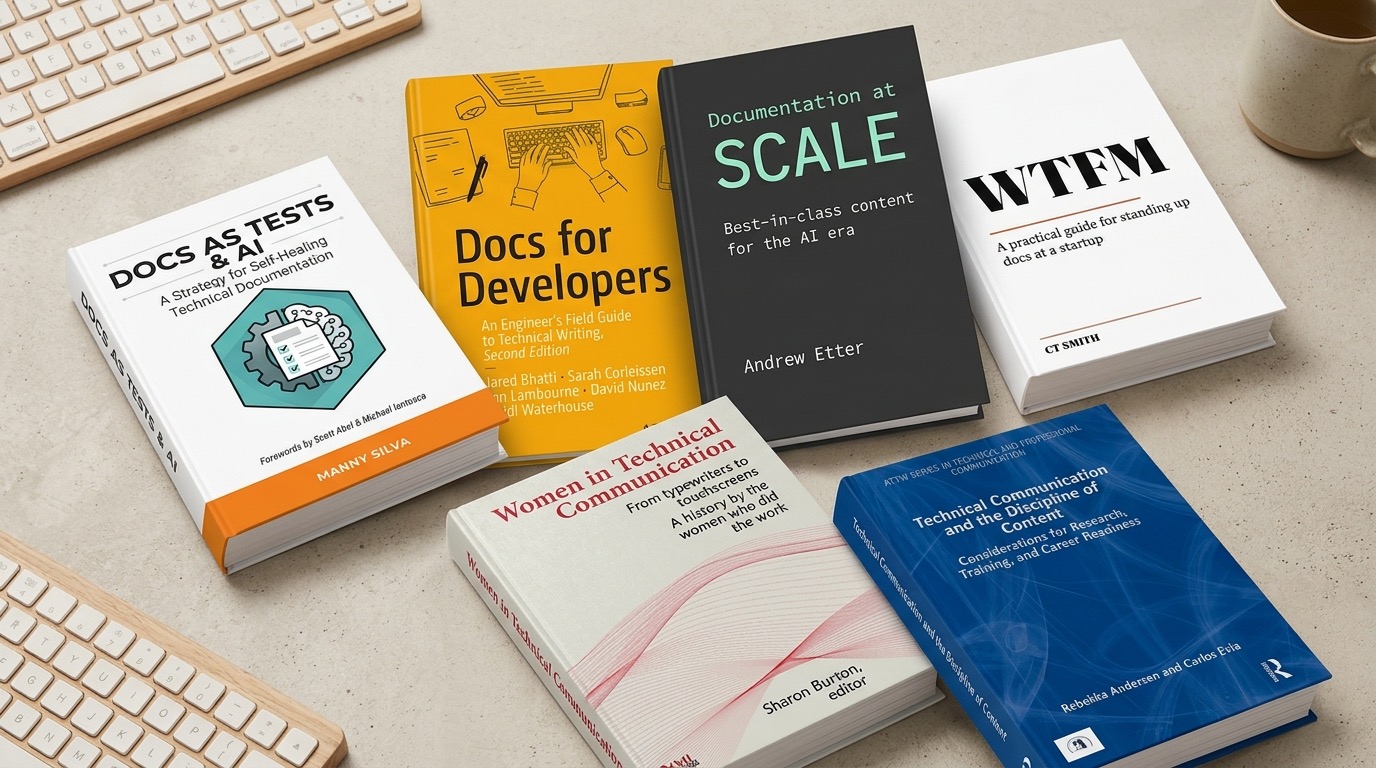
I think it’s marvelous that we’re seeing so many tech writers writing books lately. The following is a brief report on each book, drawing on the jacket copy rather than my own summaries. I’ve arranged the books by publication date, with the most recent first.
WTFM: A Practical Guide for Standing Up Docs at a Startup
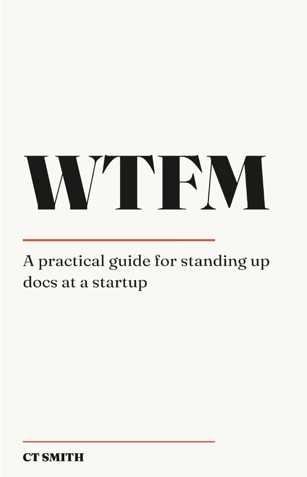
WTFM: A Practical Guide for Standing Up Docs at a Startup, by CT Smith, is a self-published guide aimed at startups without dedicated documentation teams. Published September 1, 2026, it runs 118 pages. It’s available in paperback and Kindle formats, or you can read it online for free (see the link below). From the book description:
Support is underwater. Engineers spend half their day answering the same Slack questions. You just lost a deal because the prospect asked for documentation you don’t have.
If any of this sounds familiar, WTFM is the book you need.
Written for founders, product managers, and engineers at startups — not professional technical writers — WTFM is a practical guide to standing up a documentation program from nothing. No big team. No dedicated budget. No prior experience required.
Who it’s for: Founders, product managers, and engineers at startups who need to stand up docs without a professional technical writer — though tech writers joining early-stage companies might find it interesting too.
You can read the book online for free at wtfmbook.com. Smith also discussed the book on the Behind the Docs podcast with Ren Taylor: Write the F** Manual with CT Smith.
Documentation at Scale: Best-in-class content for the AI era
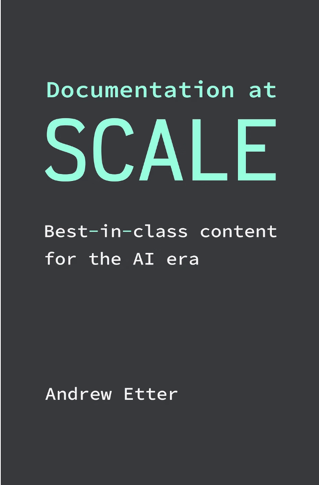
Documentation at Scale: Best-in-class content for the AI era, by Andrew Etter, is the follow-up to his influential 2016 ebook Modern Technical Writing: An Introduction to Software Documentation. Like its predecessor, it’s a short, self-published book — 84 pages, published August 27, 2026, available only as a Kindle ebook. From the book description:
The follow-up to Modern Technical Writing, Documentation at Scale covers what best-in-class documentation looks like and how to deliver it. This short, opinionated book examines why companies need technical writers, who to hire, how to think about quality, when AI can help, and where to direct your efforts. The AI era’s explosion in software development makes technical writing more important than ever. No matter the size of your company, this book can help you produce the content your users need.
Documentation at Scale is for aspiring technical writers, technical writers working in any industry, and managers with a technical writer in their reporting chain.
Who it’s for: Aspiring technical writers, working technical writers in any industry, and managers who have technical writers in their reporting chain.
Docs for Developers: An Engineer’s Field Guide to Technical Writing (2nd edition)
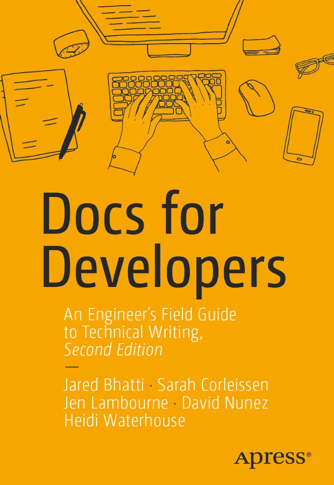
Docs for Developers: An Engineer’s Field Guide to Technical Writing is now in its second edition. The book is by Jared Bhatti, Sarah Corleissen, Jen Lambourne, David Nunez, and Heidi Waterhouse, published by Apress on June 16, 2026. The first edition came out in 2021. The book is available in paperback only (278 pages). From the book description:
Learn the craft of documentation for each step in the software development lifecycle, from understanding your users’ needs to publishing, measuring, and maintaining useful developer documentation.
Well-documented projects save time for both developers on the project and users of the software. Projects without adequate documentation suffer from poor developer productivity, project scalability, user adoption, and accessibility. In short: bad documentation kills projects. This new edition has been fully updated and edited taking into account the needs for developers and tech writers today, with new content relating to AI, automation and LLMs.
Docs for Developers demystifies the process of creating great developer documentation, following a team of software developers as they work to launch a new product. At each step along the way, you learn through examples, templates, and principles how to create, measure, and maintain documentation — tools you can adapt to the needs of your own organization.
Who it’s for: Software engineers and teams who have to document their own projects without a dedicated writer, as well as tech writers who work in developer documentation.
The book also has a companion site: docsfordevelopers.com.
Docs as Tests & AI: A Strategy for Self-Healing Technical Documentation
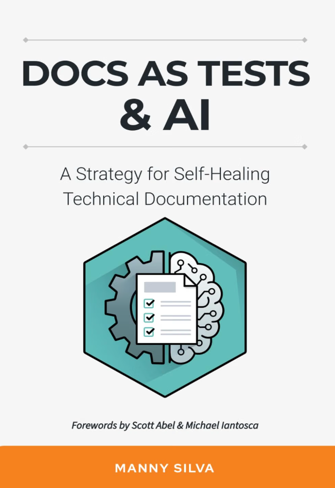
Docs as Tests & AI: A Strategy for Self-Healing Technical Documentation, by Manny Silva, is the follow-up to his earlier book Docs as Tests: A Strategy for Resilient Technical Documentation. It was published May 31, 2026 (self-published) and is available in paperback, hardcover, and Kindle formats, running 352 pages. From the book description:
Have you ever discovered that your AI chatbot was confidently wrong — thousands of times — because of one outdated paragraph? Do you even know where to check?
Documentation errors used to stay local. One user reads something wrong, gets stuck, opens a ticket. But when your docs feed chatbots, RAG systems, or coding agents, that wrong paragraph is included in every answer for every related question, and for every user, with complete confidence. One stale API endpoint. One parameter renamed three sprints ago. One screenshot of a button that no longer exists. AI doesn’t sanity-check your documentation. It amplifies it.
Docs as Tests & AI picks up where Docs as Tests left off. Manny Silva shows how to validate documentation when AI is generating it, consuming it, or both. The book covers territory the original didn’t: the difference between deterministic and probabilistic testing, validating the content that feeds AI systems, writing documentation that gives AI agents reliable process knowledge, and building systems that detect and fix errors automatically.
Who it’s for: According to the book’s site, “technical writers, documentation engineers, developer advocates, and any team using AI in their documentation workflow.” It assumes basic familiarity with documentation work but doesn’t require having read the first Docs as Tests book.
For more about the book, see the announcement on Silva’s site: Docs as Tests & AI book is Now Available!
Women in Technical Communication: From typewriters to touchscreens
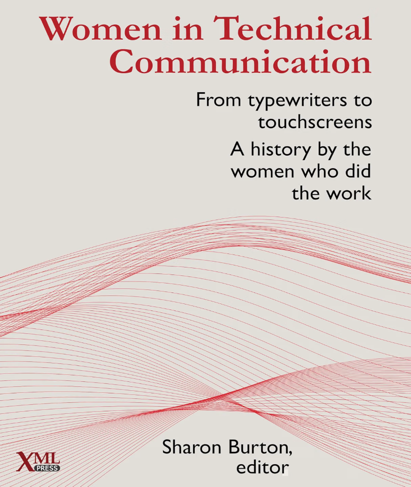
Women in Technical Communication: From typewriters to touchscreens: a history by the women who did the work, edited by Sharon Burton, was published by XML Press on March 30, 2026. The anthology gathers first-person accounts from nearly 70 women in the field. It’s a substantial book — 719 pages — available in paperback and Kindle formats. From the book description:
For the first time, the stories of the women who built the profession of technical communication have been brought together. These women helped shape how the world understands technology.
Spanning fifty years of innovation, from typewriters to personal computers to smartphones, these first-hand stories reveal how women in technical communication carved out careers, led change, and defined a field in constant motion.
Told in their own words, this anthology celebrates the pioneers who turned communication into a bridge between people and technology.
Who it’s for: Anyone interested in the history of the profession — newer practitioners who want to understand the field’s roots, and veterans who will likely recognize parts of their own careers in these first-person accounts.
To hear Burton talk about the book, listen to this Content Content podcast episode with Ed Marsh: Human widget 3592 with Sharon Burton.
Technical Communication and the Discipline of Content
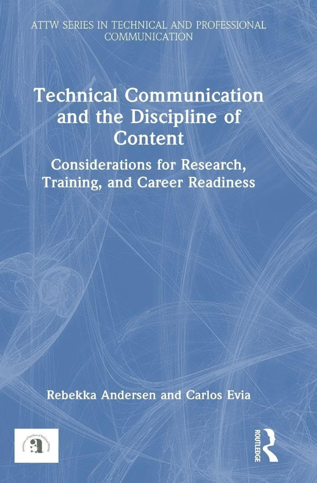
Technical Communication and the Discipline of Content, by Rebekka Andersen and Carlos Evia, is part of the ATTW Series in Technical and Professional Communication, published by Routledge on September 22, 2025. This book leans more academic than the others in this roundup. It’s available in hardcover, paperback, and Kindle formats, and runs 336 pages. From the book description:
This book explores how workflows and technologies that treat content as computable data are changing the roles, work activities, and outputs of professional technical communicators.
It describes how the need for disciplinary approaches to design, manage, and deliver content has given rise to “the discipline of content” — content strategy, content design, content engineering, content operations — that increasingly defines a facet of technical communication work in modern organizations. This book draws on extensive research of the discipline of content and dozens of interviews with industry leaders, hiring managers, and academic administrators, educators, and alumni. These first-hand accounts outline how roles and activities in content organizations are changing, how these changes are impacting hiring needs and practices, and what skills and qualities students and early-career professionals now need to obtain content-related jobs and advance to strategic positions. This book also offers guidance for building curricular pathways that prepare students for work in the discipline of content and offers strategies for enhancing pathways through industry outreach and partnerships.
Who it’s for: A more academic audience — students and early-career professionals preparing for content-related jobs, along with the educators and program administrators building curricula for them. Practitioners in content strategy, content ops, or content engineering roles may also find the industry interviews relevant.
That’s the roundup. If you know of other recently published tech comm books I missed, let me know.
Sponsored
About Tom Johnson

I'm an API technical writer based in the Seattle area. On this blog, I write about topics related to technical writing and communication — such as software documentation, API documentation, AI, information architecture, content strategy, writing processes, plain language, tech comm careers, and more. Check out my API documentation course if you're looking for more info about documenting APIs. Or see my posts on AI and AI course section for more on the latest in AI and tech comm.
If you're a technical writer and want to keep on top of the latest trends in the tech comm, be sure to subscribe to email updates below. You can also learn more about me or contact me. Finally, note that the opinions I express on my blog are my own points of view, not that of my employer.