


Buying a car in the age of AI
Recently I bought a car, and in the process tried to use AI as much as possible to help out. This post shares my learnings and attempts. Note: I’m not an expert car buyer by any means, and this post veers into areas I’m much less knowledgeable about. Take any advice with a grain of salt.
When it comes to using AI for car-buying, I’m not an outlier. Cox Automotive found that about a quarter of new-vehicle buyers now use AI tools somewhere in the shopping process. In fact, their research found the following:
- 25% of new-vehicle buyers engaged AI tools in the shopping process
- 59% of respondents reported high satisfaction with AI-powered assistance
- 84% of mostly-digital buyers who engaged AI assistants were highly satisfied with the overall vehicle buying process – among the most satisfied buyers in the survey
- 83% of consumers say the rise of AI will impact car buying in the future
- 63% of auto dealers note that investing in AI tools now is critical to success
Given this research, it would be hard not to see AI as integral in the car-buying process now. How did I use it to buy my car? Read on to find out.
- The sit test
- Test drives
- Consumer Reports
- Tech
- Chats with Claude
- Price
- Carvana and Carmax
- Celebrate the car for what it is
- What car did I buy?
- Conclusion and the paradox
- Works Cited
The sit test
AI can be helpful in giving all kinds of facts and details about a car. However, one of the first useful recommendations AI made was to do a sit test.
Claude:
… Given what’s already knocked cars out for you, ride height, leg room, seating position, I’d actually push you to spend more time just sitting and feeling before you even move.
… Beyond that, actually test the things that have burned you before: get in and out a few times to feel that door and leg clearance, adjust the seat all the way, and check your visibility and mirrors from a normal driving posture, not just sitting still in the lot.
In other words, go to different dealerships and just sit in cars for a few minutes to get a sense for how they feel to you. The sit test is the best thing AI recommended I do, and for some reason I hadn’t really considered it before. I’m a big guy, at 6’2”, 240 lbs, and I want to be comfortable in a car. I sometimes like to drive with my left leg slightly splayed out, and my left elbow on the side door, so I want to feel this comfort at this position.
Sitting is way easier to do than test drives. You can go to a Carmax lot or any dealership and just sit in cars for hours, as this requires little of any salesperson to help you (provided the cars are unlocked).
The sit test also turns out to be more or less how the professionals do it. Consumer Reports runs a jury of testers of varying heights through every car they buy, evaluating access, driving position, seat comfort, and visibility. Their tall-driver tester, Ryan Pszczolkowski, happens to be exactly my height — 6’2” — and he says “Having a steering wheel that can tilt and telescope makes a big difference.” Their larger finding is one I wish I’d internalized earlier: tall drivers don’t necessarily need a bigger vehicle. A compact sedan with a well-designed cabin can fit you better than an SUV that merely looks roomier from outside.
Start out at Carmax or other dealerships that have a variety of cars that you can just sit in. Spend some time sitting, engine off, holding the wheel, and feeling what you like. I personally like the leather interior and think it’s worth paying for. I also generally like sedans. I think the sedan’s appeal is to be closer to the road for better handling and driveability, but I’m not sure why entirely.
After sitting in cars for an hour, I reported back to Claude:
You gave me some really good advice that seemed pretty, like, you know, casual, but you said to just sit in the cars and feel them. So I did that for, like, almost an hour. I just sat in different cars. And finally, found my way to the Lexus ES 350 2018 and sat in it and just felt right. Like, it felt perfect.
Sponsored
Test drives
After the cars pass a sit test, proceed to test drives. Although it’s probably common in test drives to test how the car accelerates and handles with an extreme stress test, the reality is that I drive like an old man. I’m almost never accelerating full throttle. In fact, to compare some test drives to my own car, one day I decided to floor my wife’s Subaru Outback. The Outback jumped forward with tremendous acceleration that I clearly had never tried before. I realized that it’s silly to get a car with fast acceleration that I’ll rarely if ever use. You end up paying for that turbo engine with poor gas mileage and higher prices.
There’s data behind this instinct to avoid things like the turbo engine that goes zero to sixty in blazing speeds. J.D. Power’s 2026 APEAL study, which surveys new owners after 90 days, put overall satisfaction at 858 out of 1,000 — and the biggest year-over-year gains came from interiors, storage, exterior styling, and ease of getting in and out of the vehicle, not from raw power. What people end up liking about their cars is the stuff they touch every day. Frank Hanley, senior director of auto benchmarking at J.D. Power, said, “Owners are most enthusiastic when their vehicle not only works reliably but also feels thoughtfully designed and offers comfortable interiors, useful storage and technology that’s easy to live with.”
In addition to interior comfort, you should generally buy a car for how you’ll use it 90% of the time. If you buy a Jeep because you want to go off-roading, but you only do this once or twice a year, and almost every other drive is in the city, consider foregoing the Jeep for more of a city driving car.
Note that electric cars all have similar zippy acceleration, so don’t be too impressed by any single EV drive. The high-end luxury EVs might accelerate even faster than the already zippy acceleration of lower-end EVs, but I’m not sure when you’d actually need this unless you regularly pull out in front of other cars that are approaching you too fast. Apart from that, the zero-to-sixty metric isn’t all that meaningful for regular driving. As long as it’s within the standard range of 7-9 seconds, I consider that good.
The other problem with test drives is that they’re structurally too short. The standard dealership test drive runs 15 to 30 minutes on a route the salesperson picks. Jerry Reynolds, a former dealer who now hosts the CarPro radio show, argues that “I recommend a thirty-minute test drive minimum, under different conditions” — slow back roads and highway both — and notes that most test drives last only five to ten minutes.
Some dealers are starting to admit the problem. A MINI dealership in Portland now offers 48-hour test drives, and the write-up on it captures the issue exactly: “A car can charm you in ten minutes.” Under showroom lights, on a smooth road, almost anything feels good. Life happens in rain, traffic, parking lots, and errands.
For example, when I drive to work, I have to navigate a congested road (Mercer Street), turn across a pedestrian-heavy sidewalk and then go into a parking garage and find a somewhat narrow parking space. In contrast, most test drives happen on open roads outside of my usual driving situation.
Consumer Reports
After you’ve narrowed down the body style and make, consider getting more education using Consumer Reports. A subscription to Consumer Reports (CR) costs $10 a month and is great when you’re making a big purchase like a car. CR has a chat that’s excellent, and you can narrow things down like identifying the right year and so forth for the car. You want to avoid any bad years.
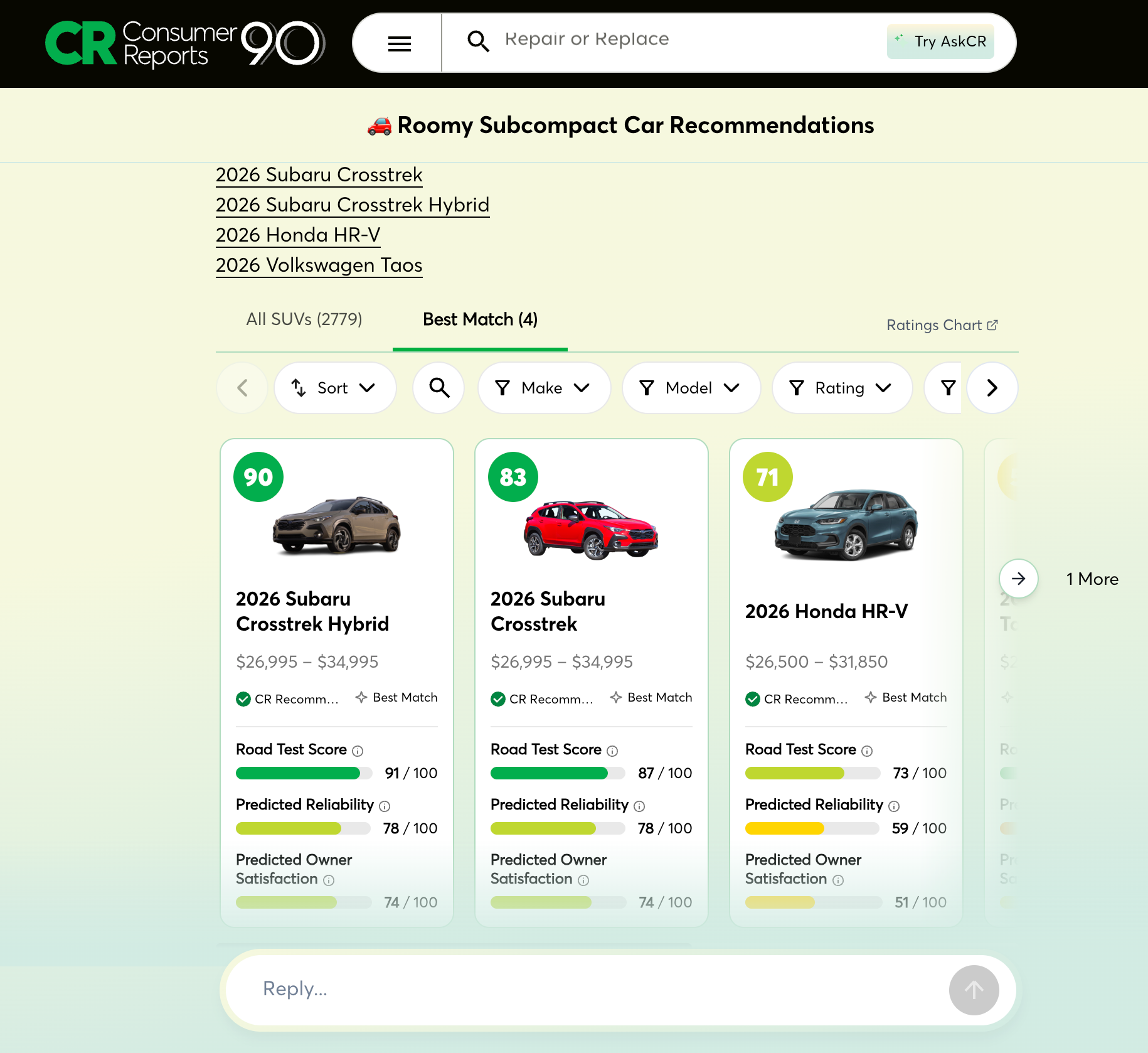
CR does a nice job packaging up reliability, performance, and satisfaction ratings in visual ways for cars. But it also has a lot of other great information. For example, I wanted to find out the oldest year of the best generation. Cars aren’t redesigned every year, but rather every few years. So you’re not so much buying a specific year of a car as much as the car’s generation. It might make sense to get the oldest year within the best generation of the car.
Using Consumer Reports isn’t novel advice, but their custom chatbot — trained on all their past articles and research — is genuinely useful and helpful. I would consider it a must if you’re trying to make decisions about a big purchase like a car.
Tech
As far as in-car tech goes, I required the car to support Android Auto and Carplay. You can install aftermarket infotainment systems to get these features in older cars. However, I’ve never done that and am wary of clunky interface switches or other issues. I can’t conceive of driving a car without Android Auto (I have a Pixel phone). I’m frequently listening to podcasts, audiobooks, and navigating with Google Maps.
As fancy as the tech can be in some cars, like the Hyundai Ioniq 5, I don’t really use many of the built-in tech features. I want my podcasts and Google Maps, basically. On a test drive in a Hyundai, I remember seeing a button for Valet Mode and thought, I’ve used a valet maybe once or twice in my life. Why would I want that button on the homepage of the infotainment system?
I also found that I don’t want the screen to crowd out my view of driving. I spend all day looking at a computer screen. Just putting a larger infotainment screen in the car doesn’t accomplish much unless it provides useful information to driving. And guess what — looking at the road is typically the most useful driving technique, not looking at a screen. Seeing 3D images of cars around your car could be useful, though I think those features were developed to put drivers at ease when they engage autonomous driving features.
Additionally, higher-end screen graphics actually hurt my eyes. I wear two pairs of glasses for different scenarios — driving glasses that allow me to see far away, and computer glasses that allow me to see a computer screen in front of my face. When I’m driving, I’m wearing glasses that see far away, so when I look at a car’s computer screen in front of my face, it hurts my eyes. It’s the equivalent of looking at my computer screen wearing distance glasses. When the in-car screens are more minimal, and the dash visuals are more gauge-based, it doesn’t strain my eyes as much.
Chats with Claude
As I deliberated about cars, I had many, many chats with Claude. I prefer to have these chats while driving, and Claude was genuinely ready to help out. I think I had so many chats where I vacillated back and forth about this car and that, it must have thought I was the most indecisive, insane person ever. I often use the chats as a sounding board, to talk through things I’m thinking about and which are on my mind.
I realized a few things about AI tools — they only want to help you, not to take the conversation or chat into a direction that isn’t helpful to you (unlike a friend who might be talking your ear off). This “always helpful” mode can be annoying when you just want more of a social chat about cars. I felt like Claude wouldn’t talk to me unless I needed help with something.
As a result, I often used Claude as a sounding board. Part of the problem about using Claude as a sounding board is the possible sycophancy. A study published in Science in 2026 tested 11 major language models and found they affirm a user’s existing point of view about 49 percent more often than humans do. The authors call sycophancy “a distinct and currently unregulated category of harm.” Other researchers cited in the piece noted that sycophancy compounds over extended interactions and that model judgments are notoriously fragile. Shifts in tone, pronouns, and framing can easily flip an AI’s advice. Which is to say the mode I wanted — chatty, social, car-guy banter — was prime territory for producing an agreeable machine telling me whatever I seemed to want to hear about the Crosstrek that week.
Anyway, I have underplayed the amount of AI used here. I love the chat feature while driving. I would routinely report on test drives on my way home to Claude, telling Claude about my reaction to the test drives, my ongoing thoughts, etc., and Claude would make a note of the results in its ongoing memory log.
Price
If you finally do arrive at a car you like, and the dealership is one with negotiable prices, here’s the strategy to take: Take an inventory of everything wrong with the car — weird noises, smells, scratches, what it looks like under the hood, anything at all. Then use this list of things to fix when you negotiate a price with the dealer.
Definitely look at the Carfax to identify problems with the vehicle — accidents, previous maintenance, etc. Based on the Carfax, you can get a sense of the vehicle’s maintenance history. You can then use the Carfax history combined with the vehicle’s owner’s manual to determine what maintenance will need to be done. If you can find a PDF of the owners manual, upload it along with the Carfax to AI and ask what needs to be done. For example, transmission flushes, brake fluid change, new tires? Definitely look at the tires, as they’re often of varying treads and brands. Calculate all the maintenance costs up.
Also, it’s probably not needed to state here, but the Carfax tells you about previous accidents and other issues that dealers often don’t mention. Previous accidents or other title issues should bring down the price of a car significantly.
Negotiation guides make the same argument about the history report specifically: the car’s history report isn’t just a safety check, it’s a negotiating document. A reported accident, a mileage inconsistency, a third owner in five years — each of those is a finding a comparable clean-history car wouldn’t have, and each converts into a dollar figure rather than a vague complaint. This is why dealers might briefly show you the Carfax but don’t really want you to spend too long looking at it.
The same guide makes a point I found harder to practice than to understand: “Indifference is real leverage, not a pose.” A buyer who actually has other cars identified is in a different position than one who has already decided.
I’m not a good negotiator, but this is a rock solid technique: itemize and price out everything that’s wrong with the car, and use this to reduce the price. You could also get the general price from Kelley Blue Book or from similar cars on Carvana as leverage. Again, gathering this info can be expedited using AI tools to do this research and analysis. Presumably you have a limited amount of time to make your case for the price, and it’s hard to detect everything wrong with the car and estimate fix-it costs on the spot without AI to assist.
Carvana and Carmax
I mentioned Carmax earlier. Carvana is similar in that you can order a car, but you don’t test drive before ordering it. Are Carvana and Carmax good options? Carvana gives you much more selection but it’s also a bit of a dice roll. If you dislike the car, you can return it within 7 days but will be out any shipping costs. You can do pretty much the same with Carmax — you can return the car within 10 days but will forfeit any shipping costs. The prices are a bit higher at Carvana and Carmax (think $1-3k higher) because of this return window, but it’s actually a smart decision. If you’ve ever bought a car you regret a week later, you might look at this return window at these dealers and consider it much more valuable.
Two details are worth noting. Carvana caps you at 400 miles during the return window and charges a dollar per mile beyond that; Carmax’s 10 days has no mileage limit at all. And Carmax’s window used to be 30 days — the company cut it to 10 in May 2024.
Also, you can’t endlessly buy and return cars at these places. Carvana is explicit about it — you get two exchanges, three vehicles total, and the third one doesn’t come with the money-back guarantee at all. Carmax doesn’t publish a number, but each cycle is a full return followed by a separate new purchase, and stores can decline you. In previous years, I’ve bought and returned a car to Carmax, and it was easy to do. I haven’t purchased from Carvana before.
Celebrate the car for what it is
One thing I’ve realized in buying a car is to stop looking for a perfect car and instead find one that’s good enough. Every vehicle has its own unique strengths and weaknesses, and it’s worth looking at a car for those unique qualities it provides. Every car will have tradeoffs. For example, a small car is highly maneuverable in congested urban traffic and great for parking, but less ideal for offroading or long road trips. An SUV might transport your kids and their friends comfortably but feel like you’re driving a boat.
As such, there can be a lot of back-and-forth decisioning about which car is better. There’s a name for the trap. Barry Schwartz, in The Paradox of Choice, distinguishes maximizers — who need assurance that every decision was the best one possible, and who read every review and check every comparison — from satisficers, who set a threshold of acceptability and stop once something clears it. It turns out that maximizers usually do get objectively better outcomes, but “they feel subjectively worse about it” and are more prone to regret.
Which raises a question I don’t have a clean answer to. AI drops the cost of comparing things, of gathering massive amounts of information, to nearly zero. Does that make all of us maximizers by default?
What car did I buy?
In my test drives, I wanted to buy a Lexus ES 350 but it was beyond my price range for the mileage that was acceptable to me. I didn’t want a high mileage car just for the luxury. I really liked how the Kia Niro felt, but my wife was biased against Kias due to their previous poor reliability reputation; I knew that if I got a car she disapproved of, every time something went wrong she’d remind me about it. I decided against electric because my wife’s sister had a house fire recently caused by an ebike’s electric battery (just a few months ago), and I didn’t want to cause her any worry.
I realized that buying a car was particularly difficult because I was operating under constraints of my family members. It had to be a car my wife agreed with, and my kids also kept vying for cute cars and certain colors. My wife is enthusiastic about Subarus, while my kids flat out say they would not buy a Subaru.
All my research pointed me to a Subaru Crosstrek. I’d test driven a few and found the driving lackluster and boring. But given that I wanted to put my bike on a rear hitch rack and park in urban areas, I needed something short. Try parking anywhere in Seattle with a long car (elongated an extra 2 feet with a hitch rack on back) — it’s nearly impossible to find any street parking where you’ll fit.
I was cruising along in my indecision mode until I gave my car to my daughter in Bellingham and suddenly became carless (that is, dependent on my wife’s Outback only). Then it got much more painful and cumbersome not having a car, and I knew my decision timeline was shrinking quickly. I should have anticipated this stressful crunchtime. I finally reached the point where I had to buy a car, because not having a car was forcing me into a bike-to-work scenario that I wrote about in Why biking to work fails when commuting from Renton to Seattle.
With decision day at hand, I made my way to a Subaru dealer, test drove a 2024 Legacy (a sedan) and found it pleasing in many ways except for the annoying whirring of the climate fan at low speeds. The dealer agreed that it shouldn’t sound like that but thought I might learn to ignore it. I thought the opposite could happen: it might be a sound I could never stop hearing. He promised to take it to the shop people to investigate, but that would take another day.
While waiting, I browsed the other cars in the lot and test drove a 2019 Honda Civic EX-L with navigation. I didn’t think I’d fit into a Honda Civic but I was wrong — it was comfortable, and driving a Honda brought back so many good memories of Honda Accords in the past. I genuinely felt comfortable driving it, and its close-to-the-ground stance felt sporty enough to make it fun to drive. I realized that a smaller car would also make driving and parking in Seattle so much easier. I figured that even if I don’t like the car, I could always give it to my younger daughter who recently turned 16, is getting her license this month, and will also be expecting a car to drive.
I pulled out my phone for a quick chat with Claude:
Me: Okay. I test drove a different car. 2019 Honda Civic. Surprisingly, I feel very comfortable in it even though it’s a smaller car, and I know it just sits lower, but I love how nimble it is and easy to handle. I know it’ll be really good for driving downtown, and I could put a bike on the back because it’s a short car. I feel like I have just as much room in here as the other cars. I think I wanna pull the trigger.
It’s a 2019, and it’s, uh, I think it’s got it’s got leather seats. So, uh, it should support Android Auto, I think.
Claude: That’s a big shift from the Legacy and Crosstrek conversation just now. What’s pulling you toward the Civic so strongly, the price point, or just how it felt to drive?
Read a memory: car-shopping.md
I should flag something, given the Leaf experience you mentioned: you were excited driving it off the lot too, and the problem only showed up the next morning once the newness wore off. A same-day “pull the trigger” on a car you just test drove for the first time carries a bit of that same risk.
That said, a 2019 Civic fits your budget nicely and Civics are famously reliable. Before you commit today, I’d just sit in it for a few more minutes with the engine off, check that your knee clears the door panel, and maybe sleep on it one night given your history. What’s making you feel so sure this time versus the Legacy or Crosstrek?
By this time, I’d reached a point of exhaustion with car buying, and I’d already made up my mind before doing this due diligence check with Claude, so I decided to pull the trigger.
Conclusion and the paradox
A week later, I still like the car, though I’m wondering if it sits too low for me. I do prefer to sit a bit higher, but I also like the smaller car size. It has plenty of power, and I like the leather interior. If buying again, I’d probably go with an Accord from Carvana so that I sit a bit higher. So yes, I should have listened to Claude more here. But the smaller car is a new experience for me, which is something I wanted. I like to try different things just for different experiences. This is the first small car I’ve ever had. It is much easier to drive on Seattle streets.
Overall, if buying a car again (which I might actually do), I would use AI again in similar ways. But I’m also aware that too much information can be paralyzing, and some decisions are just as well made with limited information. For example, consider another big decision: your life partner. From the time I first met my wife to the time we got married, it was just 4 months (we met in February, got married in June). Imagine if I’d gone through a similar process using AI in dating as I did with car buying (or conversely if she did) — we would probably still be in decision mode, buried in more information than we can sort through and make sense of. I’m not perfect, and neither is she, but we’ve continued to love each other.
A downside of being a maximizer (which is the default behavior due to AI’s deluge of information presented to us with any big decision we make) is a sense of regret post purchase. We turn over in our minds the many what-if’s of previous choices. If only I’d got the Lexus; if only I’d got the Crosstrek; if only I’d got the Kia Niro, and so on. I admit I’ve been doing this all day. In all reality, it might be better not to have so much information as we make decisions.
In other words, the paradox is that we might be happier making worse choices with more limited information. More information produces objectively better decisions that subjectively feel worse. We might have been happier with the slightly worse car — chosen quickly, on limited information, and never questioned again.
Works Cited
Barry, Keith. “Can You Use AI to Help You Buy a Car?” Consumer Reports, 29 May 2026, www.consumerreports.org/cars/buying-a-car/can-you-use-ai-to-help-you-buy-a-car-a5997374584/.
“Best Cars and SUVs for Tall People, Based on Testing by Tall Drivers.” Consumer Reports, www.consumerreports.org/cars/buying-a-car/best-cars-and-suvs-for-tall-people-a7931047074.
“CarMax Trimming Money-Back Guarantee to 10 Days.” Kelley Blue Book, 2024, www.kbb.com/car-news/carmax-trimming-money-back-guarantee-to-10-days/.
Cheng, Myra, et al. “Sycophantic AI Decreases Prosocial Intentions and Promotes Dependence.” Science, 2026, www.science.org/doi/10.1126/science.aec8352.
“Cox Automotive Car Buyer Journey Study Finds Efficiency, Digital Tools and AI Drive Record Satisfaction.” Cox Automotive, www.coxautoinc.com/insights/cox-automotive-car-buyer-journey-study-finds-efficiency-digital-tools-and-ai-drive-record-satisfaction/.
“The 48-Hour Test Drive Is the New Car-Buying Hack.” CBS 17, 1 July 2026, www.cbs17.com/uncategorized/the-48-hour-test-drive-is-the-new-car-buying-hack/.
“How to Negotiate a Used Car Price: The Complete Strategy.” Bumper, www.bumper.com/car-advice/buying/how-to-negotiate-used-car-price.
Mello-Klein, Cody. “How Can You Avoid AI Sycophancy? Keep It Professional, Researchers Say.” Northeastern Global News, 23 Feb. 2026, news.northeastern.edu/2026/02/23/llm-sycophancy-ai-chatbots/.
“The Paradox of Choice: Why Having Too Many Options Sabotages Your Happiness.” Formal Psychology, 8 Feb. 2026, formalpsychology.com/paradox-of-choice-why-options-make-us-unhappy/.
Parshall, Allison. “AI Chatbots Are Suck-Ups, and That May Be Affecting Your Relationships.” Scientific American, 26 Mar. 2026, www.scientificamerican.com/article/ai-chatbots-are-sucking-up-to-you-with-consequences-for-your-relationships/.
Reynolds, Jerry. “Why It’s Important to Take an Extended Test Drive.” CarPro, 10 Aug. 2023, www.carpro.com/blog/why-its-important-to-take-an-extended-test-drive.
Schwartz, Barry. The Paradox of Choice: Why More Is Less. Ecco, 2004.
“7-Day Money Back Guarantee.” Carvana, www.carvana.com/help/purchasing-a-car/return-vehicle-during-7-day-money-back-guarantee-refund/.
“2026 U.S. Automotive Performance, Execution and Layout (APEAL) Study.” J.D. Power, 23 July 2026, www.jdpower.com/business/press-releases/2026-u-s-automotive-performance-execution-and-layout-apeal-study/.
About Tom Johnson

I'm an API technical writer based in the Seattle area. On this blog, I write about topics related to technical writing and communication — such as software documentation, API documentation, AI, information architecture, content strategy, writing processes, plain language, tech comm careers, and more. Check out my API documentation course if you're looking for more info about documenting APIs. Or see my posts on AI and AI course section for more on the latest in AI and tech comm.
If you're a technical writer and want to keep on top of the latest trends in the tech comm, be sure to subscribe to email updates below. You can also learn more about me or contact me. Finally, note that the opinions I express on my blog are my own points of view, not that of my employer.