

Good shot, GUS!!!! How to win at pickup basketball even if you're not all that great
- Others start playing better
- You feel a natural high
- You’re more locked into the game
- Mental lock-in
- Off-the-court applications
- Conclusion
- Related resources
Every now and then I stumble across a great idea that I get really excited about but others just yawn upon hearing. This post will appeal to the pickup basketball player, of which I think there are about 5 among my audience of readers. If you don’t care about pickup bball and want to get back to work, you can stop reading here. However, this technique has been life changing and has applications off the court as well.
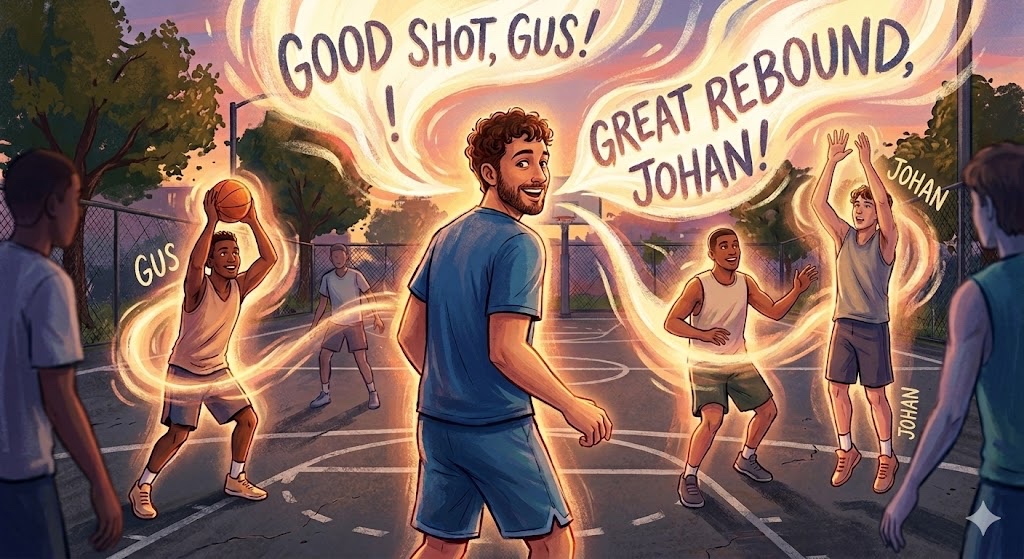
The basic technique for pickup basketball is this: praise your teammates throughout the game with comments like “Good shot, Gus!!!” Celebrate their wins enthusiastically. When Johan makes a strong rebound, shout “Great rebound, Johan!” When Andre starts hitting that three-point shot, shout “Way to drain the three, Andre!!!” and so on. Do this frequently. You don’t need to always praise good play; apparently leave a bit of randomness in the reward, praising 80% of the time or so.
After doing this for about 30 minutes into the game, you’ll start to notice several effects.
- Other players start playing better
- You feel a natural high
- You’re more locked in to the game
When everyone on your team is playing their best, your chances of winning increase significantly. Let me dive into each of these effects.

Others start playing better
Call it the Pygmalion Effect or whatever, I swear others start playing better as I praise them. I’ve seen this happen half a dozen times now. A player’s shot is off at the start, and after a few praising comments, they start getting into a rhythm and streak. They start playing better. This is really the secret of the whole psychological technique: if you want to win, you can’t do it on your own. Hero ball rarely works consistently. Instead, you need the majority of your team playing their best, playing to their strengths and hitting shots. Others really do start playing with a next-level success they don’t typically achieve as you shout effusive hype-praise like this.
By “hype praise,” I mean don’t just say “Good shot, Gus” like you’re thanking a host at a restaurant for a good meal. I mean you shout it like they just dunked thunderously on their opponent or something. “Good shot GUS!!!”
Note also that you must couple the praise with the player’s specific name. Don’t just shout “Good shot.” You have to include Gus’s name, or whomever. This means that yes, you must learn your teammates’ names to do this. Learning 5 names isn’t hard if you put forth the effort. When you couple praise with a name, the effects are massively amplified.
Additionally, because of the Cocktail Party Effect, people are much more likely to hear you when you use their names on a crowded, noisy court. (How many times have you been in another room, talking about someone and briefly mention their name; then suddenly, from another room, the person whose name was quietly mentioned perks up and asks what you’re saying!) People might ignore random comments, but their ears perk up at the sound of their name.
Getting back to my main point, it’s not just saying the person’s name, but coupling the name with praise that matters. It’s one of those psychological breakthroughs that I wish I knew earlier on in life: praise + name does much more than any kind of constructive criticism. You’ll see this on and off the court.
For an off-court example, last weekend my daughter had a “Galentine’s Day” party. During the party, she and her friends played the Jackbox pointing game where every player sees a question and they point to a person. The question was this: “Who among you will likely live the longest?” They all pointed to my Molly. She was surprised/floored by this. She told me she wants to eat healthy and exercise more because of this.
When I think about all the times I encouraged her to eat more broccoli and greens, and my recommendations fell flat, it reinforces the power of positive praise. If you want someone to do something, tell them what they’re doing right.
Psychologists say there’s an internal reinforcement in coupling the name with praise. When you say “Good shot, Gus,” Gus starts to interpret this as a self-belief: “Gus is a good shooter… I am a good shooter… Yes, I am a good shooter.” And when Gus’s confidence expands and he believes he’s a good shooter, he actually becomes a better shooter. It could simply be the power of the placebo, or the effect of playing with confidence, but either way, it works. As Gus’s shot improves, there’s a virtuous cycle of improvement. The shots dropping in reinforce his belief that he’s a good shooter, combined with the reinforced praise. I’m telling you, this technique works – try it!
You feel a natural high
Now, the second effect. Halfway into the game (e.g., 30 min of bball), you’ll feel a natural high. Shouting this kind of constant praise to your teammates has a transformative effect internally. This isn’t just a psychological hack for improving your teammates. I find myself feeling good vibes deep inside me, welling up and sprouting forth like a geyser. It feels like something tremendously good is happening to me, happening all around me. I don’t know quite how to explain it, but when I get into this mode of shouting praise for a half hour, I’m in an exceptionally good mood. It’s hard to be sour when you’re like this.
The good mood, psychologists would say, is likely due to inattentional blindness. Recall the famous Invisible Gorilla experiment, a test of selective attention in which participants are asked to count the number of times players with white shirts pass a basketball. During the middle of the exercise, a person in a gorilla suit casually walks through, beats his chest a bit, and continues out of the scene. The researchers, Daniel Simons and Christopher Chabris, found that about half of the people failed to notice the gorilla, attributing the miss to inattentional blindness.
When you’re looking for ways to praise your teammates, the same inattentional blindness is at work, but in an advantageous way: you’re unconsciously filtering out the bad (the gorillas) as your mind looks for those good moments to praise. You don’t see those times when your team is acting like the gorilla. As you become intentionally blind to the bad, it does seem that goodness is happening all around you. It’s odd and weirdly powerful.
This inattentional blindness also turns back on yourself, filtering through your own actions on the court. I’m more forgiving of my mistakes. Sensing good vibes all around, I start to feel a natural high.
One more example to drive this point home. Because most of my readers are writers, this is one you’ll certainly relate to. If you start writing more regularly, you’ll find that ideas start coming to you more frequently. Erasmus famously said, “The desire to write grows with writing.” The more you train your brain to see the world a certain way (topics to write about, for example, or thoughts to post on your social accounts), the more these ideas and thoughts start flowing. This is partly why it’s easy to write every day instead of every two weeks – the activity flips a switch in the brain that says, look for ideas, look for novel insights, etc. This looking engine runs in the unconscious background.
On the basketball court, as we’re looking for those opportunities to praise teammates, finding and celebrating the good that they’re doing, it similarly puts the brain into this state of active searching and filtering for those details. The brain starts filtering through massive incoming information and sensory stimuli seeking for matches to the desired patterns. It’s one of the most uncanny and brilliant things about our brains. Their filter systems seem to be highly neuroplastic. Start that engine looking for what’s going right, and pretty soon you’re inundated with instances of it. It feels great to suddenly unlock this perspective! Seeing so much go right leads to a natural high.
Sponsored
You’re more locked into the game
This natural high does something magical on the court: it erases the anger and frustration so many pickup ballers have towards the others on the court. Sometimes these pickup ball situations have unanticipated flareups as people go apeshit with an unjust foul call. In the past, I’ve seen people become unglued when I called a foul that they didn’t agree with. It’s like they were already having a bad day, and now this unjust call was the last straw before full on maniac mode.
But when I’ve got good vibes pouring out of me, I’m not one of those powderkegs erupting over a bad call. I’m so much more agreeable and won’t engage verbally over a trivial detail like this. For example, the other week I was playing ball at lunchtime with some people I didn’t know well. I make a hard drive to the basket and probably put my shoulder into someone too hard. I’m a big guy, but my opponent wasn’t small either. Anyway, he called an offensive foul (a rare call in pickup ball). Instead of protesting, my immediate thought was, okay. I said, “Sorry Matt, I didn’t mean to play football into you.” And I gave him the ball.
As we walked down to the other end of the court, he admitted that maybe it wasn’t a foul. But I was already empathizing with his intent — he felt I might be hurting him, so he was protecting himself physically. As someone else checked the ball, the person checking the ball sort of stopped a minute and looked surprised, as if waiting for something. As he paused, others wondered about the reason. The guy checking the ball said, “I’m just surprised there’s no arguing.” It was a rare moment, and all stopped to notice.
But here’s the thing. I wasn’t holding my tongue and feeling anger inside but not showing it. I was genuinely a bit sorry about the foul and was more than ready to give him the benefit of the doubt over the validity of the call. This is because inside I was feeling one of these natural highs since I’d been praising my teammates for the past 45 minutes — people I didn’t even know before playing. I’d made a special effort to learn their names and repeated them throughout the game with each praising comment.
Mental lock-in
Here’s what’s also happening that makes this praising comments technique especially potent as a winning formula. When you aren’t hyper-focused on unjust foul calls, you’re more locked into the game. I was watching a Lakers vs. Celtics game the other weeknight, and I was dismayed to see that after nearly every play, the Lakers players would turn to the refs with their hands raised as if to say “Where’s the call?” Or if playing defense, similarly raising their hands to express WTF frustration at foul calls.
When your mind is focused on the justness or unjustness of foul calls, it takes you out of the flow of the game. It focuses you on the other players, the refs, and this narrative of injustice (which just creates downward spirals). In your mind, you become the victim. This sense of victimhood takes you out of the flow of the basketball game itself. It puts you into a mental prison from which there’s no easy escape; the game becomes more of a one-on-one against another player that you feel has wronged you in some way. When this happens, the team’s chemistry and flow breaks down and the team rarely wins.
Shouting praising comments keeps the good vibes flowing. Even for those teammates who keep their lips zipped during the game, being the recipients of praise but not giving much of it themselves, the good vibes usually are enough to help them over any unfair foul calls as well.
Off-the-court applications
I’m looking to apply this strategy in more off-the-court situations. Obviously I can’t stroll into the office and say to my co-workers “Good email, Nancy!!!” without feeling out of context. There are moments where I can praise teammates, and I should look for these more often. But I typically have one team meeting a week, and most of the documentation I do is isolating. I chat more with AI than anyone else. I suppose in a way AI’s sycophancy is hyping me up, telling me how clever I am or how insightful or brilliant I am sometimes. Maybe with enough sycophancy, I’ll start to believe it. And maybe I should start to be sycophantic back to AI.
But more than a cycle of sycophancy, as I’ve gotten older, I’ve become more inclined toward praising others around me. I want to celebrate the positives that people are doing, to call out their strengths. So often we’re blind to those things we’re doing well. Humans are hyper-fixated on negatives. My daughter can make 30 brilliant passes and defensive plays during a soccer game, but the one time she slips up and a defender goes by, that’s the play she remembers. Or she can get all As on her report card and one B. That B will grate on her emotions. I’m tired of this mode.
I once read in a book on ADHD and girls (I have 4 girls, 2 of whom have ADHD) that ADHD girls receive something like 20,000 negative comments about their behavior growing up by the time they reach age 10 (see Jellinek). Young people grow up always hearing what they’re doing wrong. Not only is this negative feedback discouraging, if you tell someone what they’re doing wrong, they’re much less likely to correct it. Instead, focus on what people are doing right. They’ll latch onto this praising comment and amplify it. I always remember those comments where people call out something I’m doing right. So I’ve tried to do this more, to notice what someone is doing well.
For example, my daughter was telling me how cruel it is to eat lobsters, since you wait until the last minute to cook them, picking them live out of a tank. She said, imagine what that must be like, being cooked alive. Instead of engaging in a debate about animal cruelty, I thought, my child is empathetic! She’s empathizing with lobsters in a tank. Surely, this empathy is something to celebrate. There are many people out there who don’t seem to have much empathy for others around them. This empathy will likely mean she’ll be a good human being, a caring person to those around her. And yes, she does have many friends, and despite her sometimes crazy overflowing energy, this empathy is what partly draws them to her. I wanted her to know that, to know and recognize that she has empathy, because she probably doesn’t realize it.
Conclusion
To conclude this post, let me bring it back to basketball. Will this technique (“Good shot, Gus!!!”) make you win every time? Probably not every time, but — and you probably saw this coming — if you leave the court on a natural high, feeling bonded with your teammates and full of good vibes, can you really feel that you’ve lost? Even on those days when you fail, you win.
Related resources
You can listen to this post as a NotebookLM podcast.
Jellinek, Michael. “Don’t Let ADHD Crush Children’s Self-Esteem.” MDEdge. May 1, 2010
Simons, Daniel, Selective attention test. YouTube. March 10, 2010
About Tom Johnson

I'm an API technical writer based in the Seattle area. On this blog, I write about topics related to technical writing and communication — such as software documentation, API documentation, AI, information architecture, content strategy, writing processes, plain language, tech comm careers, and more. Check out my API documentation course if you're looking for more info about documenting APIs. Or see my posts on AI and AI course section for more on the latest in AI and tech comm.
If you're a technical writer and want to keep on top of the latest trends in the tech comm, be sure to subscribe to email updates below. You can also learn more about me or contact me. Finally, note that the opinions I express on my blog are my own points of view, not that of my employer.