

World Brain: No Experts podcast - Three tech writers and a photographer walk into a bar (with Tom Johnson and Floyd Jones)
- Episode 5: “Three tech writers and a photographer walk into a bar”
- Shownotes description
- The World Brain podcast’s unique angle on AI
- Podcast topics
- Related resources
- More episodes
Episode 5: “Three tech writers and a photographer walk into a bar”
Here’s the episode on YouTube:
You can also listen to the episode on Apple podcasts or Spotify.
Shownotes description
You can view the shownotes for episode 5 here on the World Brain podcast’s Substack. Here’s an extract:
Three tech writers and a photographer walk into a bar (with Tom Johnson and Floyd Jones)
Tech writers - especially those working in software development - are mostly not writing for human readers directly anymore. Increasingly the job involves using automation to generate docs that will be consumed, re-rendered by AI, then parsed into code automation tools like CoPilot or Antigravity.
Tom Johnson, a technical writer at Google, publishes thoughts at idratherbewriting.com. In this episode, Tom sits down with Yuri, Matt, and Floyd, to talk about how AI has altered his work.
One thing we discovered: like many (but not all!) highly successful, smart people, Tom is genuinely thoughtful, friendly, and good-natured. And yet, he still agreed to appear with us!
The World Brain podcast’s unique angle on AI
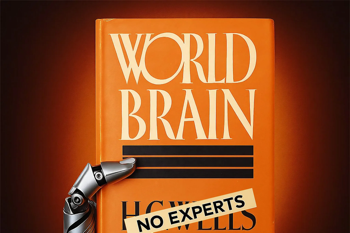
The World Brain: No Experts podcast has an interesting angle on AI. Matt and Yuri contextualize the podcast with a 1938 essay collection from H.G. Wells who wonders if “microfilm,” a newly invented technology that distributes a global encyclopedia, might bring about world peace through universal knowledge. Microfilm suggested the possibility of a universal knowledge system, shared globally, that can help organize more intellectual work. This knowledge system might prevent catastrophe at a time right before the brink of WWII. (See more about the framing in their post Yuri re-casts a more lively intro.)
The microfilm framing serves as an analogy to AI. The World Brain hosts (specifically Yuri) then say:
Taking HG Wells’s essay collection as a departure point, two old friends, Matt and Yuri, and their guests offer a hyperbolic and inexpert conversation about the screaming arrival of AI. What has been awakened? Rough beast, benevolent angel, or boring super appliance?
Are there any true experts? Could a relatively smart few could a few relatively smart outsiders be less wrong about AI? What it is, what changes it’s going to make to our lives than the glory of drunk founders, their horish enablers, or the terrifying doomsayers?
Finally, can an unstructured discussion between humans meaningfully enrich our understanding of the boundaries between us and what has been created? So, I guess the first question is glory drunk founder, horish enabler, or something else?
You might really enjoy this conversation. It’s only partly about tech writing, especially since Yuri is a photographer and coder rather than tech writer. Another guest on this episode is Floyd Jones, my former tech writing manager at Google before he retired in January. This is the first podcast (among over a hundred that I’ve recorded) where I actually appear with my manager! (Well, former manager anyway.)
Podcast topics
We chat about a lot of different topics on this podcast in a dynamic, conversational way. Here’s a list of some of the notable themes:
- Defining technical writing — We each provided our own take on what tech writing is. Floyd focused on making complex things understandable (storytelling), Matt focused on threading the needle between business goals and technical knowledge, and I noted that we’re now writing for machines/agents rather than humans.
- AI as beast, angel, or boring appliance — I tried to answer the question of the podcast’s framing about whether AI is transformative, destructive, or overhyped; the consensus is that AI is landing on “all of the above simultaneously.”
- The slow mode / active solitude counterbalance — Matt explained his analog-first practice of morning handwriting (with a pencil and paper, filling three … full … pages) as a deliberate antidote to digital acceleration.
- Corporate pressure and the fear of being left behind — Floyd and Yuri ask me about layoff anxiety, the mandate to adopt AI tools and show productivity gains, and the tension between needing to move fast and wanting to think deeply. We praise the slow movement.
- The gap between automation hype and reality — I share my experience trying to automate tech doc processes and argue that almost nobody has actually automated a repeatable workflow (instead, only granular subtasks can be automated). I promote the “cyborg” model of constant human-AI collaboration being the real current state. See also 10 principles of the cyborg technical writer.
- AI’s effect on patience, judgment, and cognition — I explain my loss of patience for long-form reading and writing (sigh). Yuri shares his concern about AI eroding his son’s ability to form independent judgment and convictions (we seem to ask AI everything now, and are incapable of arriving at our own decisions). I explain a humbling moment with Bakhtin/Gemini at the kitchen in which I realize how feeble, slow, and incapable humans are to grasp and unpack complex information. What takes me hours to absorb and understand, a machine does in a few minutes.
- Capitalism as the engine driving AI adoption — Whether the growth imperative of capitalism is pushing innovation toward a destabilizing tipping point. In short, continued hockey-stick growth requires mass AI adoption to achieve the necessary productivity, but that same widespread AI adoption eventually leads to societal collapse due to unemployment and thus the system’s demise. We also discuss whether AI is solving problems people actually have (e.g., curing cancer, scientific breakthroughs) or just generating shareholder value.
- Whose perspective is missing — Yuri made a closing point about the conversation coming from four white American men in a specific historical moment, and how AI looks different through lenses of global equity, democracy, and structural exclusion.
Related resources
Here are links related to some of the ideas I mentioned in the podcast:
More episodes
Matt and Yuri started the “World Brain: No Experts” podcast recently (in January 2026) and have 5 episodes so far. Some previous episodes include a conversation with Jobst Landgrebe, author of Why Machines Will Never Rule the World: Artificial Intelligence Without Fear, and another conversation with Chris Fregley, author of AI Systems Performance Engineering.
Sponsored
About Tom Johnson

I'm an API technical writer based in the Seattle area. On this blog, I write about topics related to technical writing and communication — such as software documentation, API documentation, AI, information architecture, content strategy, writing processes, plain language, tech comm careers, and more. Check out my API documentation course if you're looking for more info about documenting APIs. Or see my posts on AI and AI course section for more on the latest in AI and tech comm.
If you're a technical writer and want to keep on top of the latest trends in the tech comm, be sure to subscribe to email updates below. You can also learn more about me or contact me. Finally, note that the opinions I express on my blog are my own points of view, not that of my employer.